Saturday, January 17, 2009

Fault-line between Jews over Gaza

By Robert Pigott
BBC Religious Affairs Correspondent

As the bloodshed has continued in Gaza, public opinion in Israel has remained firmly supportive of the offensive against Hamas.

But the harrowing pictures of the aftermath of the conflict have raised a clamour of criticism elsewhere in the world and divided Jewish opinion overseas.

On Thursday, the Council of Jewish Communities in Morocco declared itself "in solidarity with the innocent victims who are suffering in Gaza".

It described the residents of Gaza as "sitting targets... suffering under the bombs, the widespread destruction, the lack of food and water..." and added: "The pictures of Palestinian children torn from life are unbearable."

The director of the Foundation of Judeo-Moroccan Cultural Heritage, Simon Levy, described the killing in Gaza as unjustified and "more than deplorable".

"It is not like that, that I see Judaism," he said.

'Exploiting guilt'

The idea that the assault in Gaza is tarnishing the image of Judaism internationally has been echoed by Jewish protesters in non-Arab countries.

Last week, a group of eight Canadian-Jewish women occupied the Israeli consulate in Toronto.

One of the organisers Judy Rebick, a lecturer at Ryerson University, said: "There are many Jews across the world who are ashamed and don't want this massacre to take place in our name."

My grandmother did not die to provide cover for Israeli soldiers murdering Palestinian grandmothers in Gaza
Sir Gerald Kaufman

The following day there were similar protests by Jewish women in Montreal and Boston.

Some of the strongest language elsewhere has come from British Jews, notably Gerald Kaufman - a leading figure in the Labour Party.

He accused Israel of exploiting the guilt felt by non-Jews in order to continue its offensive in Gaza.

Sir Gerald, who has been a stern critic of Israel in recent years, said: "The present Israeli government ruthless and cynically exploits the continuing guilt from Gentiles over the slaughter of Jews in the Holocaust as justification for their murder of Palestinians."

In a speech in the House of Commons, Sir Gerald recalled how his grandmother was shot by invading German troops as she lay ill in bed.

In a stinging rebuke, he said: "My grandmother did not die to provide cover for Israeli soldiers murdering Palestinian grandmothers in Gaza."

'Inexcusable'

Sir Gerald's remarks have drawn a sharp response from the Board of Deputies of British Jews, which insisted that while there was rightly a large spectrum of opinion within the British Jewish community, the "overwhelming majority" agreed that "Israel has been subjected to the most deplorable attacks from Hamas over the last eight years and that a response was necessary".

Mark Frazer, of the board's defence and group relations division, said: "The Holocaust reference is used because of the horrific images and experiences it conjures up for the Jewish community.

A pro-Israel demonstration in Manchester
Protests backing Israel have also been held across the UK

"Jews such as Gerald Kaufman feel that because of their Jewish identity they have the right to berate Israel and her supporters with this comparison without any concern for the truth.

"It is quite simply inexcusable."

However, Sir Gerald is by no means alone in stern criticism of Israel's action.

In a letter to the Guardian last week, a group of 78 people describing themselves as being "of Jewish origin" spoke of "Israeli aggression," likening it to apartheid South Africa and calling for "a programme of boycott, disinvestment and sanctions".

Liberal synagogues

Something of a fault-line exists within the British Jewish population between "cultural" and "religiously observant" Jews.

Cultural Jews differ from others because they tend not to see religious observance, or even belief, as necessary to their status as Jews, or to the preservation of the Jewish community.

Critically, the two groups often disagree about Israel, and, moreover, how far loyalty towards Israel should prevent British Jews from criticising the country.

However, in this case, religious leaders - albeit of liberal synagogues - have joined the outcry.

In a letter to The Spectator magazine, Rabbi Tony Bayfield, head of the Movement for Reform Judaism, and Rabbi Danny Rich, chief executive of Liberal Judaism - and a group of other prominent Jews - called for an immediate ceasefire and the permanent lifting of the blockade of Gaza.

Sir Gerald Kaufman
Sir Gerald Kaufman has been highly critical of Israel's actions

They expressed their "horror" at the loss of life on both sides, but said their intervention was based specifically on their concern for Israel's welfare.

They said "Israel had a right to respond" to the rocket attacks, but the "continued military offensive could strengthen extremists... exacerbate tensions inside Israel with its one million Arab citizens and... threaten to undermine international support for Israel".

As recent demonstrations in London and elsewhere have shown, what happens in the Middle East raises powerful emotions among ordinary people.

They are clearly matched by the passions aroused among Jews around the world.

I thought this was an interesting piece. It is important to remember that in any group there are a variety of opinions and perspectives. Jews are not a monolithic group and their opinions on the Gaza crisis and Israeli-Palestinian relations vary tremendously. One of my favorite human rights groups devoted to this issue is Jewish Voice for Peace, so I'll just give them a shout out here. Check their website for more info: http://www.jewishvoiceforpeace.org/

Friday, January 16, 2009

Peru court backs drunken worker

By Dan Collyns
BBC News, Lima

Peru's highest court has ruled that employees cannot be fired for turning up to work drunk.

The Peruvian government has criticised the constitutional tribunal's ruling as setting a dangerous legal precedent.

According to the judgement, sacking a worker because he is drunk is disproportionate and unreasonable.

The court said a caretaker employed by a local authority in a suburb of Lima should be reinstated after being sacked for turning up to work drunk.

According to the seven judges who make up Peru's highest judicial authority, the sacking of Pablo Cayo was excessive because he had not been violent or rude and had carried out his work as usual.

The judgment, although non-binding, has prompted debate amongst lawyers and dismay for the government.

Peru's Labour Minister, Jorge Villasante, criticised the ruling saying it could set a bad example for other workers while some lawyers have pointed out it goes against a Peruvian law prohibiting drunkenness in the workplace.

But one of the judges in the case, Fernando Calle, said the court would not revise its decision and that the caretaker, who was sacked almost five years ago, had the right to due process.

Story from BBC NEWS:
http://news.bbc.co.uk/go/pr/fr/-/2/hi/americas/7832388.stm

Thursday, January 15, 2009

Miliband regrets 'war on terror'

The idea of a "war on terror" is a "mistake", putting too much emphasis on military force, Foreign Secretary David Miliband has said.

Writing in the Guardian, Mr Miliband said the idea had unified disparate "terrorist groups" against the West.

He said the right response to the threat was to champion law and human rights - not subordinate it.

Mr Miliband is due to repeat the views in a speech later in Mumbai, India, the scene of attacks by gunmen last year.

Mr Miliband's warning comes five days before the end of US President George Bush's administration, which has led the so-called "war on terror".

The foreign secretary wrote that since 9/11 the phrase "war on terror" had "defined the terrain" when it came to tackling terrorism and that although it had merit, "ultimately, the notion is misleading and mistaken".

The phrase was first used by President Bush in an address to a joint session of Congress on 20 September 2001, in the aftermath of the attacks on New York and Washington.

Mr Miliband wrote that the phrase was all-encompassing and "gave the impression of a unified, transnational enemy, embodied in the figure of Osama Bin Laden and al-Qaeda" when the situation was far more complex.

Calling for groups to be treated as separate entities with differing motivations, he wrote that it was not a "simple binary struggle between moderates and extremists, or good and evil" and treating them as such was a mistake.

"Historians will judge whether [the notion] has done more harm than good", he said.

The phrase, informally dropped from use by the UK government several years ago, "implied a belief that the correct response to the terrorist threat was primarily a military one - to track down and kill a hardcore of extremists", he wrote.

But the stance he now promoted was international "co-operation".

Highlighting US President-elect Barack Obama's commitment to close the Guantanamo Bay detention centre, Mr Miliband said it was time to ensure human rights and civil liberties were upheld.

He suggested that the different organisations took advantage of the belief that they had one common enemy and a key way to tackle them was to stop this.

"Terrorism is a deadly tactic, not an institution or an ideology."

He is due to repeat his words in a speech later at the Taj Mahal Palace hotel, in Mumbai, India, the scene of attacks by gunmen last November.

He is in the country in an attempt to mediate tensions between India and Pakistan over the attacks which killed 179 people.

He urged Pakistan's government to take "urgent and effective action to break up terror networks on its soil" and called for a resolution over the disputed region of Kashmir.

Story from BBC NEWS:
http://news.bbc.co.uk/go/pr/fr/-/2/hi/uk_news/politics/7829946.stm

Wednesday, January 14, 2009

Politics Of Gaza Crisis May Undercut Abbas


Listen Here: http://www.npr.org/templates/story/story.php?storyId=99260606

Morning Edition, January 13, 2009 · Among the many losers in the war in Gaza may be Palestinian President Mahmoud Abbas and his Fatah movement.

At the start of Israel's offensive, Abbas said that Hamas, which controls the Gaza Strip, was at least partly to blame for the conflict because it had provoked Israel with its rocket fire.

Abbas has since toughened his criticism of Israel. But he seems to have misread popular Palestinian sentiment on the war.

While there have been massive demonstrations against Israel's assault on Gaza across the globe, similar protests have been largely suppressed in the occupied West Bank, which is run by Abbas and Fatah.

When demonstrators left a mosque in downtown Ramallah on Jan. 9, parking attendant Abdul Hakim Nakhleh watched as helmeted Palestinian police beat the largely peaceful protesters.

"People were chanting, not knowing that they would be beaten and tear-gassed," he says. "Even women were beaten by women police."

The demonstration had started out in support of the people of Gaza but turned into a protest against Abbas. The 43-year-old Nahkleh says he once voted for Abbas but will vote for Hamas from now on.

After a year of failed peace talks, Abbas is hard-pressed to convince Palestinians in the West Bank that moderation pays.

Jeweler Murad Odeh says he thinks Abbas, who is also known as Abu Mazen, will be in trouble in the next elections.

"Abu Mazen keeps talking about peace, but we haven't seen anything," Odeh says. "Despite Israel's promises to withdraw, there are still more than 600 Israeli roadblocks. They continue expanding their settlements on our land. At any time, the Israeli army can come here and arrest people. People here do not feel secure."

Abbas has clamped down on Hamas in the West Bank as he pursued peace talks with Israel — but those negotiations have stalled.

And his legitimacy is in question for another reason: His four-year term as president ended Jan. 9. His aides say legislation gives him another year. Hamas rejects this. Bitter jokes now circulate — one text message calls Abbas a "U.S.-made product" whose date has expired.

Ayman Daraghmeh, a Hamas-affiliated member of Parliament, believes Abbas has made serious mistakes in recent weeks, reinforcing the growing perception that he is a pawn of Israel and the U.S.

But however much Hamas might have gained, Daraghmeh says, the continuing split between Palestinians must be resolved so there can be new elections.

"After this crisis ends, I think people will have to sit together to end this split between Gaza and the West Bank," he says.

Daraghmeh warns that if the two sides can't work together and there is no progress in real peace talks, there could be more violence.

"People will sometimes explode suddenly … without permission from the Palestinian leadership," he says.

Abdullah Abdullah, a senior Fatah official, also hopes that the crisis in Gaza will somehow force the Palestinians to resolve their differences. He says the international community is as much to blame for the split as the Palestinians themselves.

"If the peace process were progressing normally, Hamas wouldn't be there. Extremism comes to fill a vacuum that was created by those who are not serious about peace," he says.

While loath to acknowledge that Abbas has lost ground, Abdullah does say the security forces in the West Bank have gone too far to suppress Hamas supporters.

"We don't accept them arresting any demonstrator. … It has stopped. We intervened strongly, and it has stopped," he says.

This may be too little, too late. It remains to be seen Friday — when more demonstrations are expected — whether, indeed, the Fatah-led government will allow them.

(Because of intense interest in the Israeli-Palestinian conflict, NPR makes available free transcripts of its coverage. View the free transcript of this story.)

by Anne Garrels

'More than 1,000 killed in Gaza'

Palestinian deaths in the Gaza Strip have passed 1,000, medical sources in Gaza say, as diplomatic efforts continue to reach a ceasefire.

Nearly a third of the dead are reported to be children and nearly 5,000 people have been injured.

*************************

Claims have been received by the BBC and an Israeli human rights group that Israeli troops have fired on Gaza residents trying to escape the conflict area. Israel has strongly denied the allegations.

BBC journalists in Gaza and Israel have compiled detailed accounts of the claims.

Some Palestinian civilians in Gaza say Israeli forces shot at them as they tried to leave their homes - in some cases bearing white flags.

One testimony heard by the BBC and human rights group B'tselem describes Israeli forces shooting a woman in the head after she stepped out of her house carrying a piece of white cloth, in response to an Israeli loudhailer announcement.

The Israeli military has dismissed the report as "without foundation".

The BBC has spoken to members of another family who say they are trapped in their home by fighting and have been shot at when they tried to leave to replenish dwindling water and food supplies, even during the three-hour humanitarian lull.

Israel is denying access to Gaza for international journalists and human rights monitors, so it is not possible to verify the accounts.

B'tselem said it had been unable to corroborate the testimony it had received, but felt it should be made public.

Both articles excerpted from BBC.co.uk.

That about sums it up. I asked two weeks ago at the beginning of the ivasion at what point the Palestinian death toll would outstrip Israel's justifications to prosecute a war in Gaza. So far we have no answer. 1000 Palestinians have died. Somewhere around 300 of those are children and some 500-600 are civilians. So I really wonder at what price to Palestinians Israel is willing to contibute the campaign. Hamas will fight to the end, they are plain and simple terrorists, so it is pretty obvious that they have little interest in stopping and exhibit little care for civilians. But what of Israel? It is a supposed to be a civilized, democratic, developed state. But so far it seems to be behaving with the same depraved indifference as its enemies. And that is what is really sad. Is the fight worth it if a state has to lower itself to the point of becoming a terrorist, to committing war crimes, and killing hundreds of children in order crush its enemies?

We all know Hamas is a terrorist organization. But how many civilian deaths have to occur as a direct result of Israel's counterinsurgency tactics before Israel becomes a terrorist state?

As a last note, everyone should always be suspicious when a government bans foreign journalists from reporting from the war zone. Journalists know the risks, so it is not really about their safety. At least from what I have read governments make those decisions when they are doing something untoward....or really bad.

Tuesday, January 13, 2009

A Brief, Sad news update from Gaza

From the AP:

Israeli ground troops battled Palestinian militants in the streets of a densely populated Gaza City neighborhood early Tuesday, destroying dozens of homes and sending terrified residents running for cover as gunfire and explosions echoed in the distance.

Israel's push into Tel Hawwa neighborhood was the farthest it has moved into Gaza City during its 18-day offensive against Hamas militants, and brought Israel's ground forces within a mile of the crowded city center. Palestinian hospital officials say more than 900 Palestinians, half of them civilians, have been killed.

By IBRAHIM BARZAK and JOSEF FEDERMAN


From the BBC:

Palestinian medical sources say 920 people have been killed in Gaza so far, of whom 292 were children and 75 were women. Israeli officials say 13 Israelis, including three civilians, have been killed.

Really, really sad. According to numbers from aid groups on the ground nearly 40% of the casualties in Gaza are women and children. Regardless of who is right or wrong in the larger sense, regardless of any personal biases, Israel and Hamas's actions BOTH violate international humanitarian law. BOTH sides are targeting civilian areas. International law and the laws of war as defined in the Geneva Convention (1949 and 1977) are quite clear that bombing heavily populated civilian areas is a war crime. Very sad.

To be fair, Israel is probably not directly targeting civilians the way Hamas is, but is depraved indifference or negligence much better? Especially when the civilian casualty ratio is so staggering. At best, just assuming children are verifiably civilians, 100 Palestinian children have died for every 1 Israeli civilian. Qs a contrast, during the US invasion of Baghdad the child casualty rate was less than 5%; in Israel it is currently 34%. That is fuckng staggering. And inexecusable.

Sunday, January 11, 2009

Thousands Attend Pro-Israel Peace Rally

Thousands of pro-Israel supporters have gathered in London's Trafalgar Square to call for an end to the violence in the Middle East.

Organisers said they wanted people in Gaza and Israel to live in peace, but argued that Palestinians must accept some responsibility for the conflict.

Demonstrators told the BBC they felt the rocket hits and losses Israel had suffered had been downplayed.

Chief Rabbi Dr Sir Jonathan Sacks said he wanted Hamas to "say yes to peace".

About 850 Gazans and 13 Israelis have reportedly died in 16 days of fighting.

They said the number of Israeli deaths should not be considered disproportionate to the number of Palestinian deaths, because Israelis were lucky and escaped their houses before they were hit by Palestinian rockets.

The BBC's Raffi Berg, who was at the rally, said there was a festival atmosphere as people cheered and applauded a succession of speakers who called for peace for Israel and the Palestinians.

However, an address by Rabbi Sacks was briefly interrupted when a protester, yelling through a loud-hailer, jumped into a fountain and scuffled with security officials in the icy water before being dragged out.

Police said they estimated 4,000 people are at the event in central London. Organisers say 15,000 people have turned up.

It was the first major rally organised by the Jewish community in the UK over Israel's offensive against Palestinian militants in Gaza.

It comes after prominent British Jews wrote an open letter calling on Israel to halt operations in Gaza.

We look upon the increasing loss of life on both sides of the Gaza conflict with horror
Letter by prominent British Jews

Rabbi Sacks told the crowd: "All it took to avoid this suffering was for Hamas to stop firing rockets on Israeli citizens.

"Let a voice go out today from here in Trafalgar Square, and other gatherings being held, that we want peace."

"We say to those who criticise Israel: You want Palestinian children to grow up with hope, so do we.

"You want Palestinians to be able to live with dignity, so do we."

He said the day would come when Israelis and Palestinians would live together in peace.

"It could be hundred years away, or it could be today, it is up to Hamas and the people that give them arms, for the sake of Israeli children and the Palestinian children, we say, let it be today."

'Human shields'

Henry Grunwald, president of the Board of Deputies of British Jews, addressed the crowd saying: "We are here because we believe in peace, because we believe in life, and because we want peace in life.

"The events of the past two weeks have not been a war on the people of Gaza but war on the people using them as human shields."

A small group of pro-Palestinian protesters - estimated by police to number between 80 and 100 - were being kept separate from the main body of the rally by mounted police.

Another pro-Israel peace rally is also being held in Manchester.

Meanwhile the letter, published in the Observer, warns the military action, far from improving security, will strengthen extremism and destabilise the region.

Prominent rabbis, academics and political figures supported the open letter.

A Palestinian protester stands infront of demonstrators
Some pro-Palestinian protesters attended the mainly peaceful rally

They write: "We look upon the increasing loss of life on both sides of the Gaza conflict with horror.

"We have no doubt that rocket attacks into southern Israel, by Hamas and other militant Palestinian groups, are war crimes against Israel.

"No sovereign state should, or would, tolerate continued attacks and the deliberate targeting of civilians.

"Israel had a right to respond however, we believe that now only negotiations can secure long-term security for Israel and the region."

Confrontations

On Saturday thousands of pro-Palestinian demonstrators marched through London to call for an immediate ceasefire in Gaza.

The protest started peacefully but there were confrontations as police tried to move demonstrators away from the gates of the Israeli embassy.

Protests also took place in Edinburgh, Aberdeen, Belfast, Newcastle and Southampton.

from:http://news.bbc.co.uk/2/hi/uk_news/7822656.stm

I was a little skeptical about this story at first, but in the end I appreciate the sentiment of the protesters. We should certainly not forget Hamas' role in all of this, and yes, Palestinians should accept some responsibility. So kudos to the group at least for its overall spirit and intent. That said, I do disagree with a couple of things.

The idea that Palestinian causalities should not be considered disproportionate because Israelis were lucky and escaped to bomb shelters really irks me. I have heard this argument from colleagues who took the "Birthright" trip to Israel. It seems like a common argument Israelis like to make. And there is some intuitive truth to it. I mean, if Hamas could they would kill many more Israelis, and it is only the combination of their poor weapons technology and the organization and capacity of the Israel government (in terms of bomb shelters and warning systems) that keep casualties low. Still, the argument is a bit spurious and misleading. Israel knows that Palestinians don't have access to bomb shelters. And the government of Gaza can hardly be expected to provide them when it can't even get basic medical supplies, food, or water to its people. The casualties are disproportionate because Israel is a much stronger nations with much greater firepower. And while they are typically not targeting civilians specifically the way Hamas does, their actions would be the legal equivalent to depraved indifference in most cases.

The second thing is that average Palestinians deserve any blame. Hamas militants and activists deserve blame, sure. But ordinary Palestinians? Not anymore than average Israelis deserve blame for the actions of their government, and maybe less so. Israel is a developed democracy, and if its people support the actions of hard line politicians by voting them into office it confers a degree of responsibility on the citizens. This argument was used against Palestinians by both the US and Israel when they voted Hamas into office. The argument was basically that by supporting Hamas Palestinians supported radicalism and should pay a price. And the US and Israel took measures to undermine the elected government, including a series of sanctions that led up to a nearly complete embargo of the Strip. But that was two years ago and Hamas has since lost much of its popular support. Recent public opinions polls show Hamas with declining popular support and it would have been unlikely to win any national election in the months before the Israeli invasion of Gaza.

So which group holds more sway over its government and thus their actions? Arguable neither in a lot of ways. It kind of depends on your belief in the ability of citizens in a democracy to influence policy. But if we have to compare, the nature of the systems suggests that Palestinians have much less sway over their leaders than do Israelis. So again, if blame should be conferred on the populations (and I am not saying it should), it would seem that Israelis should bear the brunt of it. Israelis can pressure their government to make concessions or to continue to bomb civilian areas. Palestinians can protest Hamas, and they sometimes do, but Hamas is more likely to quash dissent and excute "collaborators" than listen to protest. So, what say do average Gazans actually have? Israel wants the people to resist Hamas, but I don't see how they can.

As a side note, I came across this article from the BBC from earlier this week. It discusses the issue of who is a civilian in Gaza what constitutes a violation of international law and the Geneva Convention (to which Israel is not a signatory but oddly the PLO executive committee is. Hamas, of course, is not.).

http://news.bbc.co.uk/2/hi/middle_east/7811386.stm


Saturday, January 10, 2009

The unmeasurable price of war

By Paul Martin
BBC News

My close friend Ashraf and I have worked, eaten, discussed... even disagreed, through so many broadcasting assignments - some under intense pressure as Palestinian gunmen in Gaza fight Israel, or each other.

Fire in Gaza City following Israeli military operations
The Israeli attack on Gaza began on 27 December 2008

On the sixth day of this current war I could not get hold of Ashraf on the mobile phone.

Later, in tears, he told me why. His youngest brother Mahmoud, aged 12, and his 14-year-old cousin, were told it was too dangerous outside Ashraf's family home in the deserted side streets. So the children played innocently on the family home's flat roof.

Then an unmanned Israeli aircraft fired two small rockets.

Ashraf rushed upstairs and took the boys to hospital, but it was hopeless. They were buried the same day.

I have also met killers - people who have destroyed innocents like Israeli Ella or Palestinian Mahmoud

Just the latest in a series of disasters for Mahmoud and Ashraf's very dignified father, a medical doctor. He had been turned into a refugee by the 1948 war.

A year ago he lost one son, my marvellous and irrepressible cameraman Ahmed, in a car crash. And now his youngest boy, Mahmoud.

Macabre scene

Was there any reason for the rocket strike?

Possibly. The Israeli unmanned aerial vehicle may have relayed back live pictures not showing children but just some fuzzy figures moving on a rooftop. How clear the aircraft's picture of Ashraf's rooftop was, is going to be the subject of an inquiry, the Israelis have promised.

Map of the Gaza Strip and Israel

Also, Ashraf's home was close to one of the city's security headquarters.

In June 2007 I had watched - sheltering under large slabs of meat dangling in a butcher's shop - as the building was seized by Hamas forces.

I have seen civilians on the Israeli side die too, blown to bits in suicide bombings. Eleven dead - including a whole family of six in a Jerusalem side street - bits of body splattered on the walls.

There was a macabre scene in 2001 at a beachside hotel in Netanya. Knives and forks hanging embedded in the high ceiling of a dining room, where 30 elderly men and women had gathered for a festival meal, all now dead.

I sometimes lie awake and wonder, when I saw our target was close to civilians, whether I was right not to fire. Maybe I let him live and tomorrow he will kill more of our civilians
Uri, Israeli pilot
And in the Israeli town of Sderot over two years ago, I met an ambulance driver who had raced to the scene of a rocket attack that flattened a house near the Gaza border.

He found his own grandson, one-year-old Osher, lying with his left eye dangling out and his head split open. Doctors saved his life.

Then in a side street in Sderot there is a small bench, painted with red and blue flowers at the spot where 17-year-old Ella, a talented musician, was walking when a rocket hit and killed her.

Compulsion to kill

I have also met killers - people who have destroyed innocents like Israeli Ella or Palestinian Mahmoud. They have their explanations. Some months ago, I went with a Palestinian rocket-firing brigade keen to dispatch their weaponry into the heart of an Israeli town (Sderot itself actually).

Twenty-four-year-old Mohammed (on his first rocket-firing mission) said Israeli men, women and children would one day end up fighters. "So let's kill them first," he said.

Israeli police in Sderot inspect damage after a rocket was fired from the Gaza Strip
Missiles have exploded near the homes of 90% of Sderot's residents

Months later I met him in a Gaza street. He had decided to retire from rocket-firing and return to computer programming.

Hamas's prime minister has an American-educated adviser, who once told me on camera: "Our rockets are not lethal enough yet but one day, God willing, they will be."

I also met two Israeli pilots from the Cobra brigade, their twisted snakes emblazoned on the sides of their one-man helicopters, each bristling with rocket launchers and a machine gun.

One pilot, Uri, pulled down his dark-glasses visor, then whipped out a Hebrew newspaper clipping with photos of a boy and his grandfather.

They died, he said, when this man was picking up this kid from the nursery school. Uri was taking off, aiming to kill what he defined as terrorists. "I always carry these photos with me on a mission," he explained, "to remind me that when I hunt down a terrorist I am protecting people like these."

Did he sleep easy at night? I asked him.

There was a long pause. "No," he said, "I sometimes lie awake and wonder, when I saw our target was close to civilians, whether I was right not to fire. Maybe I let him live and tomorrow he will kill more of our civilians."

From neither the Israeli nor the Palestinian fighting men could I detect much empathy for the innocent.

from BBC.co.uk

I posted this since Beck wanted a little more balance on the blog. I think the article sums up sentiment on both sides pretty well. Neither Hamas gunmen nor Israeli fighters have much "empathy for the Innocent", at least so this reported would seem to describe it. And that sounds about right. Both sides are sure that what they are doing serves some greater good, either protecting the people they love from terrorists or liberating people they love from oppression. The details and debates over ideology are pointless at this moment, however, when people on both sides are dying. Granted at the moment many, many times more Palestinians are dying than Israelis, and this is par for the course (B'tselem has great statistics in great detail for any one interested). But again, debating who is more guilty is probably not getting anyone any where. We have been at this impasse for 40 years. This situation is completely untenable and unsustainable, as it has been for years. If we want balance and any sort of justice the US must start playing an active and more objective role in peace making. It can't give Israel a blank pass and only attempt to temper its actions once hundred of people have died. Israel has to stop building settlements. Full stop. It has to reduce its checkpoints. And there has to be a legit plan and time line for a two state solution. PA leaders have to take a more active role (though this is contingent on how much the US and Israel work with them rather than undermine them). And they have to make tough concessions. The right of return, as much as I am for it, will not be a negotiating point because Israel will never give in. At best, Palestinians might get some manner of compensation. That might be negotiable. But return for 10000s of Palestinians who fled 60 or 40 years ago is not going to happen, and pressing for it unconditionally will only prevent any real settlement. Israel will have to absorb attacks and stay its hand rather than retaliate. Hamas, IJ, and other groups will try to derail any process, but smacking down the whole of the population for the actions of extremists will not produce any results. They hold most of the cards, so the onus is on them to make the peace. The average Israeli has much more input and sway in their government than does the average Palestinian, so it seem like there is where the peace has to originate.


Friday, January 9, 2009

Israel 'shelled civilian shelter'

Israeli forces shelled a house in the Gaza Strip which they had moved around 110 Palestinians into 24 hours earlier, the UN quotes witnesses as saying.

The UN Office for the Coordination of Humanitarian Affairs (OCHA) called it "one of the gravest incidents" since the beginning of the offensive.

The shelling at Zeitoun, a south-east suburb of Gaza City, on 5 January killed some 30 people, the report said.

Israel says it has looked into the allegations and they are unfounded.

Israeli foreign ministry spokesman Yigal Palmor said no Israeli soldiers had been in the area on the day the incident was supposed to have happened.

*****

An estimated 770 Palestinians and 14 Israelis have died in nearly two weeks of Israel's air and ground offensive against the Palestinian militant group Hamas.

excerpted from the BBC.

I hate to beat a dead horse so to speak, but regardless of one's ideological position on this issue or distaste for Hamas, this constitutes a war crime. Come on! This is disgusting. Blame Hamas all you like but when Israel, or any country or non-state actor, shells UN positions, kills aid workers, and then shells a civilian shelter THAT THEY PUT PEOPLE INTO it is an unconcionable act that defies international law and basic respect for human life. How can this go on? How can the US not put pressure on Israel to stop the killing? This depresses to me to no end. And it depresses me how many people, especially policy makers in this country, can keep beating the same tired drum that "the fault lies with Hamas" when Israel is carrying out specifc attacks on civilians again and again. At best Israel as just as guilty as Hamas at this point.

"Like A Toyota-thon of Human carnage"

Obama to star in Spider-Man comic

Warning: This story contains plot spoilers

The Spider-Man edition is likely to become a collectors' item

US President-elect Barack Obama is to appear on the cover of a special edition of a Spider-Man comic.

A six-page story, with the superhero saving the day when an imposter tries to take Mr Obama's place as president, will hit shelves next Wednesday.

Marvel Comics editor Joe Quesada said the idea for edition came after Mr Obama admitted he was a Spider-Man fan.

"How great is that? The commander-in-chief to be is actually a nerd-in-chief," Mr Quesada said.

Mr Obama's fan status was revealed by his campaign team, who released 10 little-known facts about the Democrat.

"Right at the top of that list was he collected Spider-Man comics," Mr Quesada said.

"I was inundated with tons of fan mail saying, 'Have you read this?'

"I was just floored, absolutely floored."

Thursday, January 8, 2009

IDF Attacks UN Aid Wokers

The UN has said it is suspending aid operations in Gaza because its staff have been hit by Israeli attacks.

'Great regret'

Responding to the suspension of UN aid efforts, Israeli government spokesman Mark Regev said Israel fully supported the work of the UN and other humanitarian agencies in Gaza.

"We will do what needs to be done to facilitate this vital work," he said. "In these difficult days we must work together to meet the humanitarian needs of the population."

Our installations have been hit, our workers have been killed in spite of the fact that the Israeli authorities have the co-ordinates of our facilities
Chris Gunness
Unwra spokesman

The UN's move came shortly after it said one person had been killed and two hurt when a fork-lift truck on a UN aid mission came under Israeli tank fire at Gaza's Erez crossing.

The UN's relief agency Unwra said it was "with great regret" that it had been forced to make a difficult decision.

"We have suspended our operations in Gaza until the Israeli authorities can guarantee our safety and security," said Unwra spokesman Chris Gunness.

"Our installations have been hit, our workers have been killed in spite of the fact that the Israeli authorities have the co-ordinates of our facilities and that all our movements are co-ordinated with the Israeli army."

The UN said the movements of the truck hit at the Erez crossing had been co-ordinated and cleared with the Israeli military.

The Israeli army has not commented on that claim but has said it is looking into the matter.

In a statement, UN Secretary General Ban Ki-moon condemned the Israeli military's action.

John Ging, director of operations in Gaza for Unwra, said a convoy of two UN vehicles and an ambulance had also been fired at - although it was not clear by whom - despite having clearance for its movements from Israel.

GAZA CRISIS BACKGROUND
Smoke rises over Gaza (06/01/2009)

The incident occurred as Israel for a second day suspended its military operation for three hours to allow humanitarian aid into Gaza, he said.

Mr Ging said the Israeli military had to give his staff a credible guarantee of safety.

"If they give us clearance to move then it is wholly and totally unacceptable that their soldiers on the ground are firing on our aid workers," he said.

The International Committee of the Red Cross has also accused Israel of failing to fulfil its duty to help wounded civilians in Gaza.

The ICRC said its staff had found four weak and scared children beside their mothers' bodies in houses hit by shelling in Zeitoun.

excerpted from the BBC
http://news.bbc.co.uk/2/hi/middle_east/7818577.stm

Oh for Christ's sake! Come on. This does look just like Lebanon. Does anyone remember when Israeli missles hit a UN observer post in Southern Lebanon in 2006? The IDF has the precise positions and movements of UN workers in Gaza yet the workers are being attacked by Israeli troops on the ground? Israel is a first world military, they can coordinate this stuff well enough. If this were any other nation the US would be talking about applying economic and diplomatic sanctions. At least it finally dropped it opposition to the UN proposal. Ugh....how much collateral damage and "error" is needed before it becomes a war crime?

The 'misunderestimated' president? : A Retrospective

All politicians are prone to make slips of the tongue in the heat of the moment - and President George W Bush has made more than most.

The word "Bushism" has been coined to label his occasional verbal lapses during eight years in office, which come to an end on 20 January.

Here are some of his most memorable pronouncements.

ON HIMSELF

"They misunderestimated me."
Bentonville, Arkansas, 6 November, 2000

''I know what I believe. I will continue to articulate what I believe and what I believe - I believe what I believe is right." Rome, 22 July, 2001

"There's an old saying in Tennessee - I know it's in Texas, probably in Tennessee - that says, fool me once, shame on... shame on you. Fool me - you can't get fooled again."
Nashville, Tennessee, 17 September, 2002

"There's no question that the minute I got elected, the storm clouds on the horizon were getting nearly directly overhead."
Washington DC, 11 May, 2001

"I want to thank my friend, Senator Bill Frist, for joining us today. He married a Texas girl, I want you to know. Karyn is with us. A West Texas girl, just like me."
Nashville, Tennessee, 27 May, 2004

FOREIGN AFFAIRS

"For a century and a half now, America and Japan have formed one of the great and enduring alliances of modern times."
Tokyo, 18 February, 2002

"The war on terror involves Saddam Hussein because of the nature of Saddam Hussein, the history of Saddam Hussein, and his willingness to terrorise himself."
Grand Rapids, Michigan, 29 January, 2003

"Our enemies are innovative and resourceful, and so are we. They never stop thinking about new ways to harm our country and our people, and neither do we." Washington DC, 5 August, 2004

"I think war is a dangerous place."
Washington DC, 7 May, 2003

"The ambassador and the general were briefing me on the - the vast majority of Iraqis want to live in a peaceful, free world. And we will find these people and we will bring them to justice."
Washington DC, 27 October, 2003

"Free societies are hopeful societies. And free societies will be allies against these hateful few who have no conscience, who kill at the whim of a hat."
Washington DC, 17 September, 2004

"You know, one of the hardest parts of my job is to connect Iraq to the war on terror."
CBS News, Washington DC, 6 September, 2006

EDUCATION

"Rarely is the question asked: Is our children learning?"
Florence, South Carolina, 11 January, 2000

"Reading is the basics for all learning."
Reston, Virginia, 28 March, 2000

"As governor of Texas, I have set high standards for our public schools, and I have met those standards."
CNN, 30 August, 2000

"You teach a child to read, and he or her will be able to pass a literacy test.''
Townsend, Tennessee, 21 February, 2001

ECONOMICS

"I understand small business growth. I was one."
New York Daily News, 19 February, 2000

"It's clearly a budget. It's got a lot of numbers in it."
Reuters, 5 May, 2000

"I do remain confident in Linda. She'll make a fine Labour Secretary. From what I've read in the press accounts, she's perfectly qualified."
Austin, Texas, 8 January, 2001

"First, let me make it very clear, poor people aren't necessarily killers. Just because you happen to be not rich doesn't mean you're willing to kill."
Washington DC, 19 May, 2003

HEALTHCARE

"I don't think we need to be subliminable about the differences between our views on prescription drugs."
Orlando, Florida, 12 September, 2000

"Too many good docs are getting out of the business. Too many OB/GYN's aren't able to practice their love with women all across the country."
Poplar Bluff, Missouri, 6 September, 2004

TECHNOLOGY

"Will the highways on the internet become more few?"
Concord, New Hampshire, 29 January, 2000

"It would be a mistake for the United States Senate to allow any kind of human cloning to come out of that chamber."
Washington DC, 10 April, 2002

"Information is moving. You know, nightly news is one way, of course, but it's also moving through the blogosphere and through the Internets."
Washington DC, 2 May, 2007

OUT OF LEFT FIELD

"I know the human being and fish can coexist peacefully."
Saginaw, Michigan, 29 September, 2000

"Families is where our nation finds hope, where wings take dream."
LaCrosse, Wisconsin, 18 October, 2000

"Those who enter the country illegally violate the law."
Tucson, Arizona, 28 November, 2005

"That's George Washington, the first president, of course. The interesting thing about him is that I read three - three or four books about him last year. Isn't that interesting?"
Speaking to reporter Kai Diekmann, Washington DC, 5 May, 2006

ON GOVERNING

"I have a different vision of leadership. A leadership is someone who brings people together."
Bartlett, Tennessee, 18 August, 2000

"I'm the decider, and I decide what is best."
Washington DC, 18 April, 2006

"And truth of the matter is, a lot of reports in Washington are never read by anybody. To show you how important this one is, I read it, and [Tony Blair] read it."
On the publication of the Baker-Hamilton Report, Washington DC, 7 December, 2006

"All I can tell you is when the governor calls, I answer his phone."
San Diego, California, 25 October, 2007

"I'll be long gone before some smart person ever figures out what happened inside this Oval Office."
Washington DC, 12 May, 2008

from our friends at the BBC.

Man, it would be funny if it weren't the last eight years of reality. Let's take a look back at all of the president's achievements...on second thought let's just laugh, and cry, and the move the f*&% on in a big hurry.

Public Opinion and Gaza

Israelis back Gaza action - for now


By Heather Sharp

BBC News, Jerusalem

Rachel Schwartz, 48, cannot keep away from the television, and jumps whenever the phone rings.

Yoni
Yoni is not allowed to say where he is now

Her son Yoni, 21, is a paramedic in an elite unit in the Israeli military. His usual daily phone calls stopped the day after the Israeli ground offensive in Gaza began.

All she has heard from him since is an SMS message, on Tuesday, that read: "Don't worry, I'm fine. I love you." He is not allowed to say where he is. She assumes he is in Gaza.

Yoni is not allowed to say where he is. She assumes he is in Gaza.

Her other son, Michael, 24, was called up as a reservist at 2330 on Saturday night, and gone by 0500 the next morning.

"I'm not doing so well," she says, when asked how she is coping. "As a mother I wish it stopped yesterday, but I know that there's a job that needs to be done."

'Heavily-supported war'

Like the majority of Israelis, according to opinion polls, Ms Schwartz fully supports Israel's operation in Gaza.

Rachel with her husband Andy
Rachel says support for the war is "unanimous" in Israel

Six Israeli soldiers and, according to Palestinian medics, more than 650 Palestinians, have died in the fighting, in which Israel is attempting to vastly reduce the Palestinian militant group's capacity to fire rockets into southern Israel.

"This is one of the few wars that I think is unanimous - I've never seen the people come together, the right-wing and the left, in this way and agree that this had to be done," she says.

Professor Asher Arian, a veteran Israeli pollster, says it is a "text book case" of a "heavily-supported war".

But, he points out, support was also soaring at the start of the 2006 war in Lebanon, which ended with intense recriminations and plummeting poll ratings for Prime Minister Ehud Olmert.

A few days before Israeli tanks moved into Gaza, 52% of people asked backed the air offensive, and another 19% wanted to see it expanded with ground forces.

I think the war's stupid, it's useless - there would have been a better way
Meytal Pessing

But the transition to a ground war is a critical moment, in a country where most young people serve in the military and empathy for mothers like Ms Schwartz runs deep.

"With a ground war, everybody knows a neighbour or a cousin or a son of a friend who's involved, and that gives it a much more far reaching effect," says Prof Arian.

Time to 'get out'

In one of Jerusalem's largest malls, the view among people sipping coffee in cafes and popping in and out of shops is generally consistent.

Hava Elemelech
Hava Elemelech says the war must continue until Hamas' rockets stop

Salesman Moti Bohm, 30, backs the operation completely.

"No country can allow itself to be under attack without responding. Hamas is not a country, it's just a mob of bandits," he says.

"We must continue, until the rockets stop," says Hava Elemelech, 45, a kindergarten teacher from Beersheva, one of the towns recently reached for the first time by Palestinian rockets.

"Even if Israelis have to die," she says. "You can't make an omelette without breaking an egg."

But there are those, like housewife Galit Yeshyhu, 35, who echo concerns in Israel's left-leaning media that the troops will become bogged down, casualties will rise, and the rockets will keep coming.

"I think now is the time to get out. We have done enough. The longer we stay, the more lives will be lost."

A minority oppose the war outright. Some of those are left-wingers who have held demonstrations under slogans such as "Stop the Massacre in Gaza! Stop the bloodshed and destruction!"

But there are others too, like Meytal Pessing, 25, who describes herself as "in the centre" politically. "I think the war's stupid, it's useless - there would have been a better way."

Ratings 'war'

With the operation coming just over a month before elections scheduled for 10 February, domestic politics also plays a part.

Israeli soldiers mourn over a grave of their colleague killed in Gaza
When casualties start rising, there could be an erosion of public support

The Israeli operation was launched by the government of scandal-hit Mr Olmert's centre-right Kadima party, now led by Foreign Minister Tzipi Livni, and Defence Minister Ehud Barak, head of Kadima's largest coalition party, Labour.

Kadima has been struggling to hold onto voters disillusioned with its founding agenda of unilateral withdrawals from occupied Palestinian areas, and particularly with the ascendance of Hamas in Gaza after the withdrawal of Israeli settlers and soldiers in 2005.

Avraham Diskin, professor of political science at Jerusalem's Hebrew University says that the operation in Gaza has boosted Mr Barak's previously languishing poll ratings at the expense of centre-right opposition leader Binyamin Netanyahu.

But it has not, most pollsters say, completely wiped out the lead Mr Netanyahu has held over Ms Livni in recent months.

However, to some voters, Labour and Kadima now do not seem "as impotent as they looked before," says Prof Diskin says.

For example, prison warder Sivan Abuhatzira, 24, says "maybe" she will switch her allegiance from Mr Netanyahu to Ms Livni or Mr Barak in February.

"I didn't like them before, but they made a good decision," she says.

From BBC.co.uk

I think this is telling. And it is the same sort of argument that Israel uses to support violence against Gaza. The notion is that Palestinians supoprt Hamas, as at least implicitly and therefore have themselves to blame for Israeli attacks. This was particularly true when Hamas won elections a few years ago, but is probably less true now. But if blogs and opinion polls in Israel are accurate, Israelis broadly support the attacks on Gaza, even if it does cost innocent lives--that "omlette" quote above is disgusting. The point is, this is the sort of thing that Hamas uses to support its attacks on Israeli civilians. Their logic--deplorable as it may be--is that average Israelis support the violent actions of the government and generally approve of the killing of Palestinian civilians so they are complicit and therefore justifiable targets.

There are clearly moderate voices, particularly from the Israeli left and the Peace Now movement (you should listen to a recent interview from NPR with Israeli author Amos Oz, excellent perspective), but these groups are often marginalized in Israeli just as moderates are often supressed by Hamas in Gaza. The point being, I understand how average Israelis facing incoming Hamas rockets support the government's efforts to protect them by "going after Hamas." But do they not see that this position just lends additional support to Hamas to send those rockets, especially when that response kills so many Palestinians? Is it just that people are so focused on their immediate position that they can't see the larger picture?

Vatican deplores Gaza situation

The Pope's justice minister, Cardinal Renato Martino, has sharply criticised Israel's actions and likened the Gaza Strip to a "big concentration camp".

Correspondents say his words mark the Vatican's toughest comments since Israel began its offensive with intensive air attacks 12 days ago.

He accused both sides of only thinking of their own interests while innocent people paid the price.

Pope Benedict XVI has already called for an end to the conflict.

Cardinal Martino, president of the Vatican's Council for Justice and Peace, made the comment to Italian online site Il Sussidiario.

"Defenceless populations are always the ones who pay," he said.

"Look at the conditions in Gaza: more and more, it resembles a big concentration camp."

The BBC's David Willey in Rome says relations between Israel and the Vatican have been strained recently, after the Pope made it clear that he favoured making Pope Pius XII a saint.

The controversial wartime pope was accused by some Jews of turning a blind eye to the holocaust.

Cardinal Martino's comments were immediately criticised by Israel, who said the Vatican was repeating Hamas propaganda.

Call for intervention

Israel says it wants to stop rocket attacks on southern Israel and to stop Hamas smuggling weapons into Gaza via Egypt, while Hamas says any ceasefire deal must include an end to Israel's blockade of Gaza.

Cardinal Martino urged both sides to hold peace talks.

"If they can't come to an agreement, then someone else should do it [for them]," he said.

"The world cannot sit back and watch without doing anything."

He added: "We Christians are not the only ones to call this land 'holy', Jews and Muslims do so too.

"The fact that this land is the scene of bloodshed seems a great tragedy."

There was a brief lull in hostilities on Wednesday when Israel halted military operations in Gaza for three hours to create "humanitarian corridors" for supplies and fuel.

It followed the deadliest day of the operation - more than 130 Palestinians were killed on Tuesday, medics said.

Story from BBC NEWS:
http://news.bbc.co.uk/go/pr/fr/-/2/hi/europe/7817019.stm

Wednesday, January 7, 2009

Israeli envoy to Caracas expelled

Venezuela has ordered the expulsion of the Israeli ambassador to Caracas in protest at Israel's offensive in the Gaza Strip.

A number of diplomatic staff have been expelled along with Shlomo Cohen.

President Hugo Chavez has strongly condemned Israel for its actions and called on Israelis to stand up against their government.

Venezuela is the first country to take such a diplomatic step in protest at the violence in Gaza.

"The Israeli army is cowardly attacking worn-out, innocent people, while they claim that they are defending their people," Mr Chavez said during a visit to a children's hospital in Caracas.

"I call on the people of Israel to stand up against that government, to demand, to put a hand on their hearts and look at their children, and I call on the world to stop this madness."

Shortly after, the foreign ministry released a statement ordering the expulsion of Mr Cohen and some of his staff, in what they said was a show of solidarity with the Palestinians.

The BBC's Will Grant in Caracas says Mr Chavez often uses strong language to criticise Israel and is a close ally of Iranian President, Mahmoud Ahmadinejad, one of Israel's main enemies.

Venezuela also has a large Arab community who have welcomed the government's move, our correspondent adds.

Well Hugo, I don't agree with you on many issues, but I can respect this decision. I would like to see the world use a little more diplomatic leverage against Israel, especially in the form of symbolic gestures (at least to start). Granted Chavez likely has his own interests in mind more so than the plight of the Palestinians--needs to save face with the Arab oil exporters--but I still appreciate the gesture.

Tuesday, January 6, 2009

240,000 dollars awarded to man forced to cover Arab T-shirt

NEW YORK (AFP) – An airline passenger forced to cover his T-shirt because it displayed Arabic script has been awarded 240,000 dollars in compensation, campaigners said Monday.

Raed Jarrar received the pay out on Friday from two US Transportation Security Authority officials and from JetBlue Airways following the August 2006 incident at New York's JFK Airport, the American Civil Liberties Union (ACLU) announced.

"The outcome of this case is a victory for free speech and a blow to the discriminatory practice of racial profiling," said Aden Fine, a lawyer with ACLU.

Jarrar, a US resident, was apprehended as he waited to board a JetBlue flight from New York to Oakland, California, and told to remove his shirt, which had written on it in Arabic: "We will not be silent."

He was told other passengers felt uncomfortable because an Arabic-inscribed T-shirt in an airport was like "wearing a T-shirt at a bank stating, I am a robber,'" the ACLU said.

Jarrar eventually agreed to cover his shirt with another provided by JetBlue. He was allowed aboard but his seat was changed from the front to the back of the aircraft.

Last week, nine Muslims, including three children, were ordered off a domestic US flight after passengers heard what they believed were suspicious remarks about security.

Although the passengers, eight of them US citizens, were cleared by the FBI, they were reportedly still barred from the AirTran flight.

Security has been at a high level in US airports since the September 11, 2001 hijacked airliner attacks against the World Trade Center in New York and the Pentagon in Washington.

However, rights groups and representatives of the Muslim community say the security measures have led to frequent discrimination and harassment.

One of the few times I've heard something that came out of an ACLU lawyer's mouth, and wasn't instantly inclined to punch someone in the head. :P 

Personally, I want to believe that Americans are better than this kind of stuff. To look at someone of arabic dissent or of the muslim faith, and assume they are a suicide bomber in the making is unjust and contradictory to the very values we want to protect against Islamic radicalism in the first place. 

Now, I'm not usually a proponent of wanton litigation for every slight under the sun, and I understand that airlines are under extraordinary pressure to ensure the safety of their passengers. But in this case, being kicked off an airplane because of arabic text on your t-shirt is just inexcusable and sad, and I think an example needed to be set here. 


Strike on Gaza school 'kills 40'

At least 40 people have been killed in an Israeli air strike on an United Nations-run school in the Gaza Strip, Palestinian medical sources have said.

A number of children were among those who died when the al-Falluj school in the Jabaliya refugee camp took a direct hit, doctors at nearby hospitals said.

People inside had been taking refuge from the Israeli ground offensive.

Earlier, the International Committee of the Red Cross (ICRC) warned of a "full-blown humanitarian crisis" in Gaza.

Speaking on the 11th day of the Israeli assault, a senior ICRC official, Pierre Kraehenbuhl, said life in Gaza had become intolerable.

Palestinian medical sources say up to 600 people have been killed since the attacks began, and Mr Kraehenbuhl said much more needed to be done to protect civilians.

At least 70 Palestinians were killed on Tuesday, while four Israeli soldiers were killed by fire from one of their own tanks.

A UN-run school? Was this a facility harboring terrorists? For Christ's sake! Can someone explain at this point what possible defense there can be for Israel's actions. 600 people dead. This is shameful. Shameful that Israel continues to conduct itself in this manner, shameful that the Bush admin is doing nothing but supporting it, and increasingly shameful that Obama has made no official statement.

While understanding the need to combat terrorism, Israel cannot conduct itself like this. It is immoral and ineffective. Please, I ask everyone who stops by to visit this blog to email their senators and representatives to ask that they (at the very least) call on Israel to make a greater effort to avoid civilian casualties. Better yet, ask them to pressure Israel to end the siege of Gaza, correct the humanitarian crisis, and work to find a lasting solution to the Israeli-Palestinian conflict. Israel cannot just have a free hand and full US support to undertake tactics that kill 100s of civilian bystanders. What is the value of fighting terrorism when you kill scores of innocent people to do it?

Sunday, January 4, 2009

Israeli troops clash with Hamas

Israeli ground forces are battling Palestinian fighters in the Gaza Strip, after Israel intensified its operation to halt rocket attacks by militants.

Clashes increased in the north with both sides announcing casualties as Israeli troops in effect surrounded Gaza City and cut the territory in two.

Scores of Israeli tanks are said to have penetrated deep inside Gaza.

Many world leaders have called for an immediate ceasefire, but the US has backed its ally, Israel.

A European Union delegation is beginning a visit to the region, and Russia says it will send its envoy.

The EU foreign policy chief, Javier Solana, said the crisis represented a failure of diplomacy and everyone had to work hard to end the suffering and advance the peace process.

In other developments:

  • In the West Bank, there are angry protests against the Israeli offensive. A Palestinian man is shot dead by Israeli troops who confronted youths near the town of Qalqilya, medical and security sources say
  • At least 17 people are killed and 130 injured when Israeli shells fall near a school and the main market in Gaza City, Palestinian health ministry officials tell the BBC.
  • Hamas radio and TV report the capture of two Israeli soldiers during the fighting, but the Israeli army says it has no knowledge of the claim
  • In his first public comments since the ground offensive began, Israeli Prime Minister Ehud Olmert says the operation was "unavoidable", but that he will not allow a humanitarian crisis in Gaza
  • At least 32 missiles are fired into Israel from Gaza, targeting Sderot, Netivot and other communities close to the border. One woman is slightly injured in Sderot
  • A tank shell fired in northern Gaza kills 12 people, most of them civilians, Palestinian sources say

Many claims cannot be verified. Israel is refusing to let international journalists into Gaza, despite a Supreme Court ruling to allow a limited number of reporters to enter the territory.

Northern battles

Witnesses say the attack began when Israeli military convoys supported by attack helicopters crossed into northern Gaza at four separate points after nightfall on Saturday.

By late Sunday afternoon, large plumes of smoke could be seen rising over the northern part of the Gaza Strip as Israeli forces stepped up their offensive.

The BBC's Mike Sergeant on the border with Israel says that although the sounds of explosions, gunfire and helicopters remain constant, the fighting seems to be moving away from the northern end of the territory, and heading further west.

Israeli tanks and heavy armour appear to have moved in on either side of Gaza City, in effect cutting the territory into two along the Salah al-Din Road, he adds. The town of Beit Hanoun has also reportedly been surrounded.

Scores of advancing Israeli tanks are reported to be in battles around Gaza City and the northern towns of Beit Lahiya and the Jabaliya refugee camp.

Israeli troops have meanwhile taken control of the site of the former Jewish settlement of Netzarim, just south of Gaza City.

According to witnesses, Israeli troops have largely remained in the open and not entered urban areas.

The Israeli military says that Hamas fighters are not engaging with them in close combat. Instead, they are using mortars and improvised bombs.

The Israeli military said 40 sites had been targeted, including tunnels used for smuggling, weapons depots and rocket launch sites.

Sources inside Gaza say at least 30 people have been killed in the fighting since Saturday evening, several of them civilians, and dozens were injured.

The Israeli army said one of its soldiers had been killed and 32 wounded in the ground offensive, at least one of them critically.

'Long campaign'

An Israeli military source told the BBC it was unrealistic to stop all the rocket fire, but the army believes it can be decreased and made less accurate.

HAVE YOUR SAY Violence brings only more violence. If the killing doesn't stop there would be no truce. Nour Hafez, Kuwait

The move into Gaza had been preceded by some of the heaviest Israeli air and artillery attacks on the territory in more than a week of bombardment.

Israeli warplanes and naval vessels have carried out more than 800 strikes on the Gaza Strip since the offensive started eight days ago, including 40 on Saturday.

The UN has warned of a worsening humanitarian crisis, and believes a quarter of the 485 Palestinians killed by Israel so far were civilians. Israel says about 80% of those killed were Hamas militants. Four Israelis have been killed by rocket fire from Gaza.

Story from BBC NEWS:
http://news.bbc.co.uk/go/pr/fr/-/2/hi/middle_east/7810270.stm

This is only going to get worse. And worse and worse. Already there are nearly 500 Palestinian deaths, and at least 125 of those are civilians, including a number of children. That is more casualties than Hamas has inflicted in Israel in the past 5 years or more.

My bet is that it looks just like Lebanon in 2006. But hey, maybe Israel will succeed in putting an end to Hamas once and for all. And then all of the death and destruction will be worth it, right? Which reminds me, no one answered my previous question: How many Palestinian civilian deaths can be justified by annihilating Hamas? So far we have about 125, not counting all those who died as a result of the embargo and previous airstrikes. Is 1000 acceptable? This completely sickens me.

Thursday, January 1, 2009

Blagojevich's pick has résumé chiseled in stone


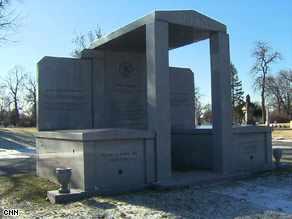
(CNN) -- Anyone who doubts Roland Burris' qualifications to serve as the next senator from Illinois may want to head to Chicago's Oak Woods Cemetery.

There, Burris, whom embattled Illinois Gov. Rod Blagojevich appointed to succeed President-elect Barack Obama in the Senate on Tuesday, has erected a granite mausoleum listing his many accomplishments.

Under the seal of the state of Illinois and the words "Trail Blazer," Burris, 71, has listed his many firsts in granite, including being the state's first African-American attorney general and the state's first African-American comptroller.


The memorial also notes that Burris was the first African-American exchange student to Hamburg University in Germany from Southern Illinois University in 1959.

There appears to be enough room to add "U.S. senator" to the memorial, but Burris may never get a chance to serve in Washington.

A Senate Democratic aide told CNN on Wednesday that plans were in the works to prevent Burris from being seated in the Senate.

After Blagojevich made the surprise move to appoint Obama's successor, Senate Democrats praised Burris but said they could not accept any appointment by Blagojevich after his arrest on corruption charges earlier this month. Federal prosecutors say he conspired to "sell" Obama's Senate seat for campaign donations and other favors.


LOL! Ok, right up until this moment, I was ambivalent about Blago's senate pick, because there's no way in hell anyone is going to let that joker make the call anyway. But this is... well, this is telling, isn't it?

So, Mr. Burris erects a monument to himself, headlined with the self annointed title "Trail Blazer", and slaps his resume across it. He even has a bench there for pilgrims visiting his grave site. Quite thoughtful. Another interesting tidbit: his two children are named, I shit you not, Roland and Rolanda.

Anyone willing to take a wager that he might have buried a few dozen terra cotta warriors around the perimeter, too? 

It's a good thing he wasn't elected President or anything... I'm not sure the cemetary has enough room for a pyramid. Though a full scale model of Illinois bedecked with jewels, gold foil, and rivers of mercury would be neat.