Monday, July 14, 2008

Sudan head accused of war crimes


Omar al-Bashir (March 2008)
Sudan says an indictment of Mr Bashir would harm any prospects of pea

Sudan's president has been accused of genocide, crimes against humanity and war crimes in Darfur by the prosecutor of the International Criminal Court.

Luis Moreno-Ocampo told judges at The Hague that Omar al-Bashir bore criminal responsibility for alleged atrocities committed over the past five years.

The three-judge panel must now decide whether there are reasonable grounds for an arrest warrant to be issued.

Sudan's government has warned the move will undermine peace process in Darfur.

The country does not recognise the ICC and has refused to hand over two suspects who Mr Moreno-Ocampo charged last year, Humanitarian Affairs Minister Ahmad Harun and militia leader Ali Kushayb.

It has also labelled Mr Moreno-Ocampo a criminal, and warned that any indictment could stall peace talks and cause mayhem in Sudan.

I am big proponent of the ICC, and I was particularly disappointed when George W. removed former president Clinton's signature from the Rome Statute. Bashir no doubt deserves to be prosectued for war crimes--the evidence of his complicity in the Darfur gencoide is pretty clear. But I am not sure that this is the best time for the international community to make a legal move. Critics are probably right to suggest that the indictment could overturn the peace process and endanger peacekeepers on the ground. So, while I am all for the indictment in theory, it seems an unwise move unless the international community is ready to signifcantly beef up the international peacekeeping force or make some other move to end the conflict. Otherwise, it would be best to wait--they can always get him later.

Thursday, July 10, 2008

Israelis Propose Laws To Punish Terrorists' Families

Morning Edition, July 10, 2008 · Following last week's bulldozer rampage in Jerusalem, some Israeli politicians want to pass laws that penalize families of people who launch attacks. That would mean revoking health insurance and unemployment benefits for Arab residents of East Jerusalem. While some Jewish lawmakers say it's necessary for Israel to toughen laws, critics say the proposals are about revenge.


http://www.npr.org/templates/story/story.php?storyId=92398760

This is seriously repugnant. This summary doesn't explicitly mention it, but if you listen to the story one of the proposals is that the family homes of terrorists would be demolished. I mean, come the fuck on. This is even more repugnant when you consider that extended families often occupy the same home--grandparents, cousins, etc. Collective punishment is certainly the policy of the Israeli regime, but this is another step all together. Could we imagine a US law that would bulldoze the homes of the families of anyone who committed a murder? I also can't find how this would be productive at all. It would seem to only increase the likelihood that a punished third party would then turn to violence against Israel. Ughh...

Take a listen to the story. I could only get the brief summary from the NPR webpage.

Tuesday, July 8, 2008

Cold War take 2

The United States has criticised what it calls "bellicose rhetoric" from Russia over US plans to develop a missile shield in Europe.

Russia said it would be forced to react with military means if the US went ahead with its plan for a shield based partly in the Czech Republic.

The reaction was "designed to make Europeans nervous about participating" said a Pentagon spokesman.

A White House spokesman said dialogue with Russia would continue.

"We seek strategic cooperation on preventing missiles from rogue nations, like Iran, from threatening our friends and allies," said White House spokesman Gordon Johndroe.

He said the US and Russia should be "equal partners".

Moscow says siting the system near its borders could weaken its own defences, despite US assurances that it is designed to counter a threat from the Middle East, not from Russia.

It has previously threatened to aim its own missiles at any eventual base in Poland or the Czech Republic.

A deal, signed by US Secretary of State Condoleezza Rice in Prague on Tuesday, allows a tracking radar base to be set up on Czech territory.

'Not our choice'

The Russian foreign ministry statement said: "If a US strategic anti-missile shield starts to be deployed near our borders, we will be forced to react not in a diplomatic fashion but with military-technical means."

Condoleezza Rice on the need for a missile shield

It said there was "no doubt that the grouping of elements of the strategic US arsenal faced towards Russian territory" would mean Moscow had to "take adequate measures to compensate for the threats to its national security".

"This is not our choice," it added.

The foreign ministry said it would continue to monitor developments but would remain open to constructive talks on issues of strategic stability.

The BBC's Adam Brookes in Washington cites Russia's ambassador to the UN as suggesting that the phrase "military-technical means" does not mean military action, but more likely a change in Russia's strategic posture, perhaps by redeploying its own missiles.

More likely still, our correspondent says, is that the Russians are trying to frighten the Czech parliament into backing out of the whole deal.

The next question, he says, is whether Poland will accept missile defence facilities as well, and how the Russians will respond to that.

The plans remain unpopular in the Czech Republic, while the US has failed to reach agreement with Poland on placing other parts of the system there.

The plans involve siting the tracking radar system in the Czech Republic and 10 interceptor missiles in Poland. The US wants the sites to be in operation by about 2012.

No doubt Russia is acting in a bellicose manner and upping the anty to an unnecessary level. But still, the US should expect such a response. This is exactly how wars begin. This is classic security dilemma and the first thing you study in intro to international relations. The undergrads I teach can see this. Hell, I taught this to middle school students (albeit scary bright middle school students) last summer and they all understood it. The core here is that the US IS acting provactively by putting up the missle shield. It removes any strategic balance Russia had by having nuclear weapons (i.e. the Cold War balance). So, Realist theory predicts that Russia would react to the dimiishment in its security by threating the US and, possibly, considering pre-emptive military action. Realism is very clear on these issues, yet surprisingly even people in the Realist theoretical camp (I am looking at you Condy) seem to make the same bad choices.

Gorbachov's, brains...ummmm, brains

Gorbachov: The Music Video - Bigger and Russianer

The following is a music video for a Russian Metal Band called ANJ, for their earnest song tribute to Mikael Gorbachov (Russian spelling). According to it Russian history includes a zombie uprising that is thwarted by Conan the Barbarian's older Russian Brother. which leads them to capitalist consumerism.

Apparently we missed the zombie uprising, since we already have capitalist consumerism. Who knew?

(BTW It's in HD, so let it load a bit before you play it and then click the little "four arrows" symbol on the lower right part of the viewer to see it in full-screen HD)

GORBACHOV: THE MUSIC VIDEO - BIGGER AND RUSSIANER from Tom Stern on Vimeo.

Monday, July 7, 2008

Porn and Rugby...

Porn appears on rugby programme

New Zealand rugby team performs haka
Some New Zealand rugby fans were shocked by unexpected pornography

New Zealand rugby fans watching a regular sports programme found themselves viewing hardcore pornography instead on Sunday afternoon.

Four minutes of pornography interrupted sports coverage on the Prime Television channel, after what a spokesman described as a distribution mix up.

The pornographic footage was meant for an adult pay-per-view channel.

Instead, it found its way onto a regular free-to-air programme called "Grassroots Rugby".

Rival television channels reported that some viewers were angry about the broadcast, which may have been seen by children.

Just for laughs....

BBC: "Iraq floats US pullout timetable"

Iraqi Prime Minister Nouri Maliki has raised the prospect of setting a timetable for the withdrawal of American troops from Iraq.

Talks are continuing on a new security deal, but the US has said it opposes setting any timetable for withdrawal.

The UN mandate under which US troops stay in Iraq expires at the end 2008.

Correspondents say Mr Maliki may have an easier time getting the support of Iraqi MPs by proposing a deal which includes a withdrawal timetable.

US and Iraqi governments have been negotiating a detailed bilateral Status of Forces Agreement (SOFA) since March and it was supposed to be concluded this month.

Many Iraqis want to see an end to the American military presence in their country, but are fearful of the consequences for security.

In violence on Monday, a female suicide bomber killed nine people and wounded 12 others in an attack on an Iraqi market, police said.

Respect for sovereignty

A statement from Mr Maliki's office quoted him as telling Arab ambassadors in the UAE: "The direction we are taking is to have a memorandum of understanding either for the departure of the forces or to have a timetable for their withdrawal."

"The negotiations are still continuing with the American side, but in any case the basis for the agreement will be respect for the sovereignty of Iraq."

It was the first time that the prime minister had specifically suggested the setting of a timetable for a US withdrawal.

US officials in Baghdad did not issue an immediate reaction to the comments.

The American position has always been that setting a timetable for withdrawal gives an advantage to insurgents who have been battling US forces since the 2003 invasion which overthrow Saddam Hussein.

A possible withdraw from Iraq has become a major issue in the US presidential election campaign and could also figure prominently in local elections in Iraq in October.

Story from BBC NEWS:
http://news.bbc.co.uk/go/pr/fr/-/2/hi/in_depth/7493782.stm

Saturday, July 5, 2008

Sean Hannity...

...gets to call himself a news anchor for some reason?

Friday, July 4, 2008

On Iran, top military officer sounds like Obama

Joint Chiefs Chairman Mullen urges diplomacy, not use of force
By Tom Curry
National affairs writer
updated 5:05 p.m. ET July 3, 2008

WASHINGTON - It could turn out to be one of the most significant comments of the 2008 campaign — but coming just ahead of a holiday weekend, it isn’t getting much notice.

Upon his return from a visit to Israel and Europe, the nation’s highest ranking military officer warned Wednesday that a military strike on Iran would be a very bad idea.

“This is a very unstable part of the world, and I don't need it to be more unstable,” said the chairman of the Joint Chiefs of Staff, Adm. Michael Mullen.

He added pointedly, “we haven't had much of a dialogue with the Iranians for a long time,” seeming to imply that the Bush administration should be talking to the Iranian government.

Democratic presidential nominee Sen. Barack Obama has said that if elected, he would begin talks with Iran, without any precondition.

The Bush administration has insisted that before talks can begin, Iran must cease its nuclear enrichment — a step toward building nuclear weapons.

Republican presidential nominee Sen. John McCain has said that his rival's willingness to hold direct talks, without preconditions, reveals "the depth of Sen. Obama's inexperience and reckless judgment.”

Adm. Mullen, much like Federal Reserve chairman Ben Bernanke, is one of those powerful unelected officials whose words could, at times, have as much effect on the campaign as Obama and McCain themselves.

It’s unusual for a military officer, especially the nation’s highest ranking one, to warn in such explicit terms of potential military action and to so emphatically call for diplomacy.

“What struck me about the comments was that he called for dialogue with Iran in his preliminary statement, even before he was responding to (reporters’) questions,” said Jon Alterman, the director of the Middle East Program at the Center for Strategic and International Studies in Washington.

Alterman pointed to Mullen’s opening statement in which he said, “I'm convinced a solution still lies in using other elements of national power to change Iranian behavior, including diplomatic, financial and international pressure. There is a need for better clarity, even dialogue at some level.”

Not ruling out use of military force
President Bush, McCain, and Obama, all say they would not rule out the use of military force to prevent Iran from building nuclear weapons.

But Mullen appeared to be edging toward saying that military action, either by Israel or the United States, or both, would be catastrophic.

He also warned that the United States would be hard pressed to conduct operations against Iran, given the commitment of tens of thousands of U.S. troops in Iraq and Afghanistan.

“From the United States' perspective, the United States' military perspective, in particular, opening up a third front right now would be extremely stressful on us,” Mullen told reporters. “That doesn't mean we don't have capacity or reserve, but that would really be very challenging.”

And, he added, “The consequences of that (military action) sometimes are very difficult to predict.”

Mullen explained, “Just about every move in that part of the world is a high-risk move. And that's why I think it's so important that the international piece, the financial piece, the diplomatic piece, the economic piece be brought to bear with a level of intensity that resolves this.”

The Israeli air force staged a large-scale drill last month that some observers saw as a warning of a possible Israeli attack on Iran.

But Mullen assured reporters Wednesday that “the Israeli press reported fairly widely that…those exercises were planned and routine.”

In 1981, the Israeli air force destroyed the Osirak nuclear reactor in Iraq. The Israeli government believed Saddam Hussein's regime was planning to use the plant to make nuclear weapons in order to destroy Israel.

An attack on Iranian nuclear sites could cause the Iranian regime to attack shipping in the Strait of Hormuz, through which one-fifth of the world’s total daily oil demand is carried.

Oil prices hit a record high of nearly $146 a barrel on Thursday. As Americans drive during this July 4 vacation, one reason they're paying more than $4.50 a gallon in some parts of the country is the growing tension over Iran.

Iranian Foreign Minister Manouchehr Mottaki said in an interview with The Associated Press Wednesday that the United States and Israel would not risk such an attack.

“The Israeli government is facing a political breakdown within itself and within the region, so we do not foresee such a possibility for that regime to resort to such craziness," Mottaki said. “The United States, too, is not in a position where it can engage in, take another risk in the region.”

In Congress, some members have expressed their fear that the Bush administration might launch a unilateral attack on Iran.

But last year the House rejected, by a vote of 288 to 136, an amendment offered by Rep. Peter DeFazio, D- Ore., that would have prohibited funds being used to take military action against Iran without specific authorization from Congress — unless Iran had first attacked the United States.


Good for the military. I am glad they have decided that diplomacy is equally as valuable as violence. I am not sure if their opinion would be the same if they weren't bogged down, discredited, injured, and under-resourced by wars in two Southwest Asian countries (not that I am blaming the military itself for that). But it is refreshing to see the institution warn publicly against aggression. It almost sounds like a plea to the current (and future) administration: "Please God don't commit us to another war. You're killing us here George!"

Thursday, July 3, 2008

Google must divulge YouTube log

Google must divulge the viewing habits of every user who has ever watched any video on YouTube, a US court has ruled.

The ruling comes as part of Google's legal battle with Viacom over allegations of copyright infringement.

Digital rights group the Electronic Frontier Foundation (EFF) called the ruling a "set-back to privacy rights".

The viewing log, which will be handed to Viacom, contains the log-in ID of users, the computer IP address (online identifier) and video clip details.

While the legal battle between the two firms is being contested in the US, it is thought the ruling will apply to YouTube users and their viewing habits everywhere.

Viacom, which owns MTV and Paramount Pictures, has alleged that YouTube is guilty of massive copyright infringement.

Legal action

When it initiated legal action in March 2007 the firm said it had identified about 160,000 unauthorised clips of its programmes on the website, which had been viewed more than 1.5 billion times.

Following the launch of its billion-dollar lawsuit, YouTube introduced filtering tools in an effort to prevent copyright materials from appearing on the site.

The US court declined Viacom's request that Google be forced to hand over the source code of YouTube, saying it was a "trade secret" that should not be disclosed.

But it said privacy concerns expressed by Google about handing over the log were "speculative".

The ruling will see the viewing habits of millions of YouTube users given to Viacom, totalling more than 12 terabytes of data.

Viacom said it wanted the data to "compare the attractiveness of allegedly infringing video with that of non-infringing videos."

'Erroneous ruling'

The EFF said: "The Court's erroneous ruling is a set-back to privacy rights, and will allow Viacom to see what you are watching on YouTube.

"We urge Viacom to back off this overbroad request and Google to take all steps necessary to challenge this order and protect the rights of its users."

The body said the ruling was also potentially unlawful because the log data did contain personally identifiable data.

The court also ruled that Google disclose to YouTube the details of all videos that have been removed from the site for any reason.

Story from BBC NEWS:
http://news.bbc.co.uk/go/pr/fr/-/2/hi/technology/7488009.stm


Freaking boo! What a terrible ruling. I understand wanting to protect intellectual property but I for one haven't even ever upoloaded anything to Youtube but I have a login and Google has my name and IP address and I don't want this information given out for any reason, nor do I want anyone to have unfettered access to my viewing log. This is a setback to privacy and internet rights. Boo I say, boo!

Monday, June 30, 2008

Africa urged to act on Zimbabwe

The UN has urged African leaders at a key summit in Egypt to try to negotiate a solution to the crisis in Zimbabwe.

UN Deputy Secretary General Asha-Rose Migiro said this was the "moment of truth" for the African Union leaders.

President Robert Mugabe is attending the meeting. He was sworn in on Sunday after a victory that observers said had been undermined by pre-poll violence.

South Africa has now urged Mr Mugabe to hold talks with the opposition towards forming a transitional government.

Mr Mugabe claimed a landslide victory as the sole candidate after the leader of the opposition Movement for Democratic Change (MDC), Morgan Tsvangirai, withdrew.

Draft resolution

Ms Migiro told the leaders of the 53-nation bloc: "This is a moment of truth for regional leaders... the secretary-general urges your excellencies to mobilise support for a negotiated solution."

She added: "This is the single greatest challenge to regional stability in southern Africa."

Ms Migiro again expressed UN regret that the election had been allowed to go ahead despite the violence.

In his welcoming speech, host President Hosni Mubarak said bolstering peace and security was "essential for resolving disputes and conflicts in the continent".

The AU has a rule not to accept leaders who have not been democratically elected - but observers say it is unlikely to take such strong action against Mr Mugabe so quickly.

A draft resolution written by African foreign ministers during talks ahead of the summit did not criticise the elections or Mr Mugabe, but condemned violence in general terms and called for dialogue.

Independent observers have criticised the poll.

The AU's own monitors said on Monday: "The vote fell short of the African Union's standards of democratic elections."

However, the said they were "encouraged" by the willingness of the MDC and Mr Mugabe's Zanu-PF to hold talks.

Earlier the Southern African Development Community (Sadc) observers said there was "politically-motivated violence, intimidation and displacements".

The Pan-African Parliament called for fresh elections to be held, saying the vote was not free or fair.

On Monday South Africa's foreign ministry said Zanu-PF and the MDC "must enter into negotiations which will lead to the formation of a transitional government".

The MDC has previously criticised South Africa's role and on Monday called for an additional mediator to be appointed to work alongside President Thabo Mbeki.

Also on Monday, France's Foreign Minister Bernard Kouchner said the election was a "farce" that it could not accept.

UK PM Gordon Brown said: "I hope that the African Union and its leaders will make it absolutely clear that there has to be change and a new government has got to be brought in."

Separately, on the eve of the summit, Zambian President Levy Mwanawasa, one of Mr Mugabe's leading critics, was rushed to hospital in Sharm el-Sheikh suffering chest pains. He is said to be stable.

Spoilt ballots

Mr Mugabe was sworn in during a quickly convened ceremony on Sunday, about an hour after the Zimbabwe Electoral Commission announced the results of the presidential election run-off.

Robert Mugabe is sworn in as Zimbabwe's president

The commission said Mr Mugabe won 85.5% of the vote, but many ballots were spoiled.

In a speech that followed the swearing-in ceremony, Mr Mugabe said he was committed to talks with the opposition to find a solution to the political crisis.

However, BBC Southern Africa correspondent Peter Biles says the opposition may reject any notion of a government of national unity in which Mr Mugabe is still in a key position.

The MDC said some 86 of its supporters were killed and 200,000 forced from their homes by militias loyal to the ruling Zanu-PF party in the weeks preceding the run-off.

The government has blamed the MDC for the violence.

Mr Mugabe has been in power since Zimbabwe gained independence from Britain in 1980.

Story from BBC NEWS:
http://news.bbc.co.uk/go/pr/fr/-/2/hi/africa/7480584.stm


This is just a topic we have not touched on and it is of major importance in the region. I encourage you to check out the actual article for a map of the nations surrounding Zimbabwe and their positions on the matter.

Saturday, June 28, 2008

A chicken in every pot and a handgun in every purse

A powerful pro-gun lobby group in the United States has filed legal challenges to handgun bans in San Francisco and Chicago.

The lawsuits come a day after the US Supreme Court ruled that a ban on the private possession of handguns in Washington DC was unconstitutional.

The National Rifle Association (NRA) says it wants similar bans in other states and cities overturned as well.

San Francisco's mayor says he plans to fight the NRA challenge.

The NRA lawsuit in San Francisco challenges the city's handgun ban in public housing; while in Chicago it challenges a ruling that makes it illegal to possess or sell handguns in the city.

"In Washington DC, or in any state, whether you live in the housing projects or a high end suburb, you have the right to defend yourself and your family at home," said Chris Cox, from the NRA.

"These laws all deny that right."

Self-defence

The NRA is joined in the San Francisco suit by a gay man living in a government-owned housing development who says he needs a gun to protect himself from potential hate crimes.

San Francisco Mayor Gavin Newsom said the city would "vigorously fight the NRA" and said the ban was good for public safety.

"Is there anyone out there who really believes that we need more guns in public housing? I can't for the life of me sit back and roll over on this. We will absolutely defend the rights of the housing authority," Mr Newsom said.

The Supreme Court's ruling says that the constitution "protects an individual right to possess a firearm unconnected with service in a militia, and to use that arm for traditionally lawful purposes, such as self-defence within the home".

The ruling enshrines for the first time the individual right to own guns and limits efforts to reduce their role in American life.

"The Supreme Court's decision was very encouraging, but it is just a start," NRA lawyer C D Michel said.

Story from BBC NEWS:
http://news.bbc.co.uk/go/pr/fr/-/2/hi/americas/7478832.stm

Damn it, this is exactly what I was afraid would happen. I don't get this ruling at all. Prohibiting a class or category of guns in not a violation of the Second Amendment. Otherwise, the court should have ruled that the assault weapons ban and the ban on sawed off shotguns was a violation. I am starting to think that I know stray dogs that would make better decisions that Justice Asinine Scalia. Anyway, the point being, I am a gun owner, and I support the right of American's to own guns. But I also support significant constraints on these rights. For example, why is it that one must have a license to drive a car but not to shoot a gun? People that are wishy-washy on gun control seem to be misinformed about the laxity of current gun laws. I like to encourage all of my students to visit a gun show someday just for the cultural experience. I like to go myself, but it is always a little frightening (the scary conspiracy theory militia folk are an added bonus). Most people are shocked to learn how fucking easy it is to get a gun--last year I purchased a ticket to a gun show walked right up to a table and paid 100 dollars cash for a surplus military rifle--no id check, no signature, no questions asked. I also bought 50 rounds of ammunition at the next table. I am glad I am able to purchase the weapon, I love target practice. But I would also feel way more secure if I had had to show some official idea, maybe prove that I had taken a safety class, or had my info logged into some database.

Lastly, for those on the blog who disapprove of the court's recent ruling on executing child rapists because it overturned a state law approved by voters, how does this sit with you? If a state or municipality votes to ban some weapons or all weapons why should the court get to overturn it? (For the record I don't agree with that logic. People vote for all manner of retarded and vile things, and it is only the rule of law that prevents democracy from turning abysmally foul).

Thursday, June 26, 2008

A little inappropriate religious humor

This picture kills me. Thank Matt for the contribution. I am just the holy messenger of mirth.

An Important Campaign Announcement from Barack Obama

*I was having major trouble Copying/Pasting the video. I couldn't get the embedded code to replicate and I wasn't about to type that crap out. Feel free to do it yourself and post it here Reed/Beck/Matt, you can get it from this address: http://www.youtube.com/watch?v=Snsnqbq_OCo "


Transcript:
Hi, this is Barack ObamaI have an important announcement and I wanted all of you – the people who built this movement from the bottom-up – to hear it first. We’ve made the decision not to participate in the public-financing system for the general election. This means we’ll be forgoing more than $80 million in public funds during the final months of this election.It’s not an easy decision, and especially because I support a robust system of public financing of elections. But the public financing of presidential elections as it exists today is broken, and we face opponents who’ve become masters at gaming this broken system. John McCain’s campaign and the Republican National Committee are fueled by contributions from Washington lobbyists and special interest PACs. And we’ve already seen that he’s not going to stop the smears and attacks from his allies running so-called 527 groups, who will spend millions and millions of dollars in unlimited donations.From the very beginning of this campaign, I have asked my supporters to avoid that kind of unregulated activity and join us in building a new kind of politics – and you have. Instead of forcing us to rely on millions from Washington lobbyists and special interest PACs, you’ve fueled this campaign with donations of $5, $10, $20, whatever you can afford. And because you did, we’ve built a grassroots movement of over 1.5 million Americans. We’ve won the Democratic nomination by relying on ordinary people coming together to achieve extraordinary things.You’ve already changed the way campaigns are funded because you know that’s the only way we can truly change how Washington works. And that’s the path we will continue in this general election. I’m asking you to try to do something that’s never been done before. Declare our independence from a broken system, and run the type of campaign that reflects the grassroots values that have already changed our politics and brought us this far.If we don’t stand together, the broken system we have now, a system where special interests drown out the voices of the American people will continue to erode our politics and prevent the possibility of real change. That’s why we must act. The stakes are higher than ever, and people are counting on us.Every American who is desperate for a fair economy and affordable healthcare, who wants to bring our troops back from Iraq. Who hopes for a better education and future for his or her child, these people are relying on us. You and me. This is our moment and our country is depending on us. So join me, and declare your independence from this broken system and let’s build the first general election campaign that’s truly funded by the American people. With this decision this campaign is in your hands in a way that no campaign has ever been before. Now is the time to act. Thank you so much.


I have some thoughts on this, but I have to go to work right now. I will express my opinion tonight in the comments section. BTW, I have the internet again - woohoo! I'm back online!

Wednesday, June 25, 2008

Child rapists can't be executed, Supreme Court rules

WASHINGTON (CNN) -- The U.S. Supreme Court ruled 5-4 Wednesday that child rapists cannot be executed, concluding that capital punishment can be applied only against murderers.
The ruling stemmed from the case of Patrick Kennedy, who appealed the 2003 death sentence he received in Louisiana after being convicted of raping his 8-year-old stepdaughter.

Justice Anthony Kennedy wrote in the majority opinion that execution in this case would violate the Eighth Amendment's prohibition against cruel and unusual punishment, citing "evolving standards of decency" in the United States.

Such standards, the justice wrote, forbid capital punishment for any crime other than those that take a life.

"We conclude that, in determining whether the death penalty is excessive, there is a distinction between intentional first-degree murder on the one hand and nonhomicide crimes against individual persons, even including child rape, on the other," wrote Kennedy, who is not related to the convicted rapist.

Patrick Kennedy, 43, would have been the U.S.'s first convicted rapist since 1964 to be executed in a case in which the victim was not killed.

Kennedy was convicted of sexually assaulting his stepdaughter in her bed. The attack caused severe emotional trauma, internal injuries and bleeding to the child, requiring extensive surgery, Louisiana prosecutors said.

In the majority opinion, Anthony Kennedy acknowledged "the victim's fright, the sense of betrayal, and the nature of her injuries caused more prolonged physical and mental suffering than, say, a sudden killing by an unseen assassin."

But the justice -- supported by Justices John Paul Stevens, David Souter, Ruth Bader Ginsburg and Stephen Breyer -- wrote that when determining what punishment the Eighth Amendment prohibits, "evolving standards of decency that mark the progress of a maturing society" must be taken into account.

After a review of the "history of the death penalty for this and other nonhomicide crimes, current state statutes and new enactments ... we conclude there is a national consensus against capital punishment for the crime of child rape," Anthony Kennedy wrote.

Attorneys at the Capital Appeals Project who represent Patrick Kennedy issued a statement applauding the ruling.

"We can only hope that the money that Louisiana has been spending drafting and defending this anomalous and unconstitutional statute will be reallocated to efforts at treatment for victims of sexual abuse and for measures that actually reduce the risk of such abuse in our communities," attorney Ben Cohen said in the statement.

Justice Samuel Alito wrote the dissent, saying, "the harm that is caused to the victims and to society at large by the worst child rapist is grave." He was supported by Chief Justice John Roberts and Justices Antonin Scalia and Clarence Thomas.

Alito also wrote that the majority ruled against the death penalty "no matter how young the child, no matter how many times the child is raped, no matter how many children the perpetrator rapes, no matter how sadistic the crime, no matter how much physical or psychological trauma is inflicted and no matter how heinous the perpetrator's criminal record may be."

Wednesday's ruling will affect six states that allow the death penalty for rape, including Louisiana, where Patrick Kennedy was recently joined on death row by another convicted child rapist, Richard Davis.

Because of the ruling, the sentences of Davis and Kennedy will automatically be commuted to life in prison without the possibility of parole, the Capital Appeals Project said.

"Mr. Kennedy, who has consistently maintained his innocence, plans to continue to pursue his appeals in state and federal court," the appeals project said.

Florida, Montana, Oklahoma and South Carolina have death-penalty laws for rape but have not applied them in decades. Texas enacted a version a year ago, but no defendant has been designated death-eligible for child rape in any state but Louisiana.

U.S. Supreme Court rulings in 1976 and 1977 barred capital punishment for rape and, by implication, any other crime except murder. But in 1995, Louisiana passed a law allowing execution for the sexual violation of a child under 12. State lawmakers argued that the earlier high court cases pertained only to "adult women."

Supporters of Louisiana's law say that besides murder, no crime is more deserving of the death penalty than child rape and that the punishment would be used only in the most heinous of circumstances.

"A lot of people think there should not be a death penalty because the child survives," sex crimes prosecutor Kat Bartholomew said. "In my opinion, the rape of a child is more heinous and more hideous than a homicide."

She said a sexual assault on a child "takes away their innocence. It takes away their childhood. It mutilates their spirit. It kills their soul."

Death penalty opponents contend, among other things, that it could give attackers a reason to murder their victims. In Wednesday's ruling, Anthony Kennedy agreed, writing, "A state that punishes child rape by death may remove a strong incentive for the rapist not to kill the victim."
After the ruling, Lynn, a cousin of the victim's, said, "Just knowing the kind of man [Patrick Kennedy] is, we'll never be comfortable."

The high court has in recent years banned execution for the mentally retarded, underage killers and those deemed to have had an inadequate defense at trial.

Other state and federal crimes theoretically eligible for execution include treason, aggravated kidnapping, drug trafficking, aircraft hijacking and espionage. None of these crimes has been prosecuted as a capital offense in decades, if ever.

An uncomfortable topic... and one we have discussed previously. I'm still conflicted over the subject, but in the end, I can't help but feel the Supreme Court has (again) fallen on the wrong side of the issue. I just can't help but feel that it should be up to the citizens of a given state as to whether or not they apply capital punishment to child rape, regardless of what my personal feelings on the matter might be. Personally, I'd commute the death penalty of a spy or a traitor before I'd do so for a convicted child rapist.

Thursday, June 19, 2008

Upscale urban tactical gear


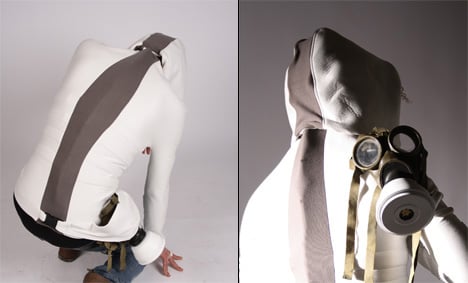
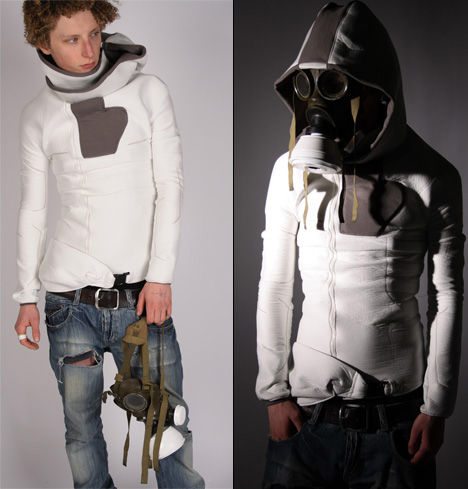
Who says protecting yourself from sniper attacks or chemical warfare needs to be ugly business? Certainly not Dutch designer Tim Smit. His “Urban Security Suit” will be all the rage in a war zone near you. Made of stylish neoprene and strategically lined with body molded kevlar, this runway show stopper will be THE must have accessory for your next war, skirmish, struggle, conflict, combat zone or civil strife you find yourself in or starting. Aeon Flux eat your heart out.


Designer: Tim Smit


from:http://www.yankodesign.com/index.php/2008/04/28/body-armor-fashion-design-armorni/

Wednesday, June 18, 2008

And now for something completely different

The world can make a saving throw.

Friday, June 13, 2008

Israel-Palestine Fatality Data

Fatalities

Click on the numbers for a list of individual names and details about the circumstances of their death.

29.9.2000-31.5.2008
Occupied Territories
Israel
Gaza Strip West Bank Total
Palestinians killed by Israeli security forces
2941 1777 4718 67
Palestinians killed by Israeli civilians
4 41 45
Israeli civilians killed by Palestinians
39 197 236 485
Israeli security force personnel killed by Palestinians
97 147 244 90
Foreign citizens killed by Palestinians
10 7 17 37
Foreign citizens killed by Israeli security forces
4 6 10
Palestinians killed by Palestinians
442 135 577


Additional data (included in previous table)
Occupied Territories
Israel
Gaza Strip West Bank Total
Palestinian minors killed by Israeli security forces
633 311 944 3
Israeli minors killed by Palestinians
4 35 39 84
Palestinians killed during the course of a targeted killing

Palestinians who were the object of a targeted killing
150 82 232
Palestinians killed by Palestinians for suspected collaboration with Israel
11 109 120
Palestinians who took part in the hostilities and were killed by Israeli security forces
1176 461 1637 58
Palestinians who did not take part in the hostilities and were killed by Israeli security forces ( not including the objects of targeted killings).
1378 837 2215 5
Palestinians who were killed by Israeli security forces and it is not known if they were taking part in the hostilities
387 479 866 4

Notes:

  1. The data may change due to ongoing research, which produces new information about the events .
  2. The figures do not include :
  • Palestinians who died after medical treatment was delayed due to restrictions of movement .
  • Palestinians killed by an explosive device that they set or was on their person .
  • 12 Palestinian citizens of Israel killed within Israel by the Israeli Police in October 2000 .
  • One Jewish Israeli citizen killed within Israel by a Palestinian-Israeli citizen in October 2000 .
  • Two Jewish Israeli citizens and One member of the Israeli security forces, killed by a Palestinian citizen of Israel in Nahariya in September 2001 .
  • Four Palestinian-citizens of Israel killed by IDF gunfire in the Territories .
  • One Palestinian-citizen of Israel killed by Border Police gunfire within Israel in July 2003 .
  • Five Palestinian citizens of Israel killed by an absconded IDF soldier on a bus in Shfar'am, within Israel , in August 2005 and the shooting soldier, beaten to death by Palestinian-citizens of Israel.
  • Seven members of the Ghaliya family (the two parents and their five children, one an adult), who were killed in June 2006 in an explosion on the coast by Beit Lahiya, in the northern Gaza Strip. The cause of the explosion remains unclear.
  • One Palestinian resident of a-Sheikh Sa'ed was killed on May 2007 during a fire exchange between Palestinian militants and Israeli policemen at the a-Sheikh Sa'ed checkpoint in East Jerusalem.
  • One Twelve-year-old Israeli child who, in August 2007 while on a family visit in the village of Saida in Tulkarm district, was killed by undercover troops who had come to arrest his brother and his brother's friend, who were wanted by Israel.
  • One Israeli citizen from Kfar Qana, who was killed in August 2007 in the Old City in East Jerusalem after he grabbed a security guard's weapon.
Source: The B'tselem , the Israeli Center for Human Rights in the Occupied Territories

In light of some of our past discussion I thought some people might find this interesting. No real comment, the data speaks volumes.

Experts unveil 'cloak of silence'


Orchestra
A working device could be used to enhance the acoustics of concert hal

Being woken in the dead of night by noisy neighbours blasting out music could soon be a thing of the past.

Scientists have shown off the blueprint for an "acoustic cloak", which could make objects impervious to sound waves.

The technology, outlined in the New Journal of Physics, could be used to build sound-proof homes, advanced concert halls or stealth warships.

Scientists have previously demonstrated devices that cloak objects from microwaves, making them "invisible".

"The mathematics behind cloaking has been known for several years," said Professor John Pendry of Imperial College London, UK, an expert in cloaking.

"What hasn't been available for sound is the sort of materials you need to build a cloak out of."

Sound shield

The Spanish team who conducted the new work believe the key to a practical device are so-called "sonic crystals".

These artificial composites - also known as "meta-materials" - can be engineered to produce specific acoustical effects.

Acoustic cloak simulation
Sound waves are channelled around an object by sonic crystals

"Unlike ordinary materials, their acoustic properties are determined by their internal structure," explained Professor Pendry.

These would be used to channel any sound around an object, like water flowing around a rock in a stream.

"The idea of acoustic cloaking is to deviate the sounds waves around the object that has to be cloaked," said Jose Sanchez-Dehesa of the Polytechnic University of Valencia, one of the researchers behind the new work.

He believes a material that consists of arrays of tiny cylinders would achieve this effect.

Simulations showed that 200 layers of this metamaterial could effectively shield an object from noise.

Thinner stacks would shield an object from certain frequencies.

"The thickness depends on the wavelength you want to screen," he told BBC News.

Sub systems

Dr Sanchez-Dehesa now wants to make and test such a material in the lab to confirm the simulations.

But researchers, such as Professor Pendry, believe the initial work is already an important first step.

Woman with finger on lips
Acoustic cloaks could be used to make soundproof rooms or buildings

"It's not an unrealistic blueprint - it doesn't demand that we do extraordinary things," he said. "This is something that can easily be manufactured."

If a material could be commercialised, both researchers believe it could have many applications.

Walls of the material could be built to soundproof houses or it could be used in concert halls to enhance acoustics or direct noise away from certain areas.

The military may also be interested, the researchers believe, to conceal submarines from detection by sonar or to create a new class of stealth ships.

However, the material may need to be optimised first.

"You don't want to wrap a submarine in something that is heavy and several inches thick," said Professor Pendry. "It would add quite a lot to the Navy's fuel bill, I think."

Light touch

The research builds on work by scientists from Duke University in North Carolina, US, and the Hong Kong University of Science and Technology.

Invisibility cloak   Image: Duke University
Duke University researchers created an invisibility cloak in 2006

Earlier this year, independent teams from the two institutions demonstrated the mathematics necessary to create an acoustic cloak.

Other scientists have shown that objects can be cloaked from electromagnetic radiation, such as microwaves.

For example, in 2006, scientists at Duke University showed how a small copper cylinder could be rendered invisible from microwaves.

The technique used a metamaterial consisting of 10 fibreglass rings covered with copper elements, to deflect the microwaves around the object and restore them on the other side.

To an observer it looked like the microwaves had passed straight through the cylinder.

Other researchers hope to build the holy grail of cloaking: an invisibility device that would channel light at wavelengths normally visible to the eye.

However, this technology is in a more primitive state, according to Dr Sanchez-Dehesa.

"We believe the acoustic cloak is more feasible than a similar device for light," he said.

From BBC.co.uk

This is what I like to see, more science devoted to creating D&D magical items and various spells. What we need now is a cone of cold, a cloak of elven-kind, and a ring of the arachnid. Yeah, that would be sweet.

Monday, June 9, 2008

Go Hanuman, Go!

Indian school names monkey god as its chairman

By BISWAJEET BANERJEE
Associated Press Writer

He's a revered Hindu monkey god. And now, he's the chairman of an Indian business school.

Hanuman, the popular god known for his strength and valor, has been named official chairman of the recently opened Sardar Bhagat Singh College of Technology and Management in northern India, a school official said Saturday.

The position comes with an incense-filled office, a desk and a laptop computer. Four chairs will be placed facing the empty seat reserved for the chairman and all visitors must enter the office barefoot, said Vivek Kangdi, the school's vice chairman.

"It is our belief that any job that has the blessings of Lord Hanuman is bound to be a success," said Kangdi.

All Hindus know that Hanuman can lift mountains and leap oceans, but ancient texts make no mention of his business acumen.

"When we were looking for a chairman for our institution, we scanned many big names in the field of technology and management. Ultimately, we settled for Lord Hanuman, as none was bigger than him," Kangdi said.

Hanuman is one of the most popular gods in the crowded pantheon of Hindu deities. His most famous feat, as described in the Hindu epic the Ramayana, was leading a monkey army to fight the demon King Ravana and rescue a kidnapped princess.

The Sardar Bhagat Singh College in Lucknow, the capital of Uttar Pradesh, India's most populous state, awards bachelor's degrees in engineering and management. The school opened last year.


As reported by the AP wire service.

He tried to eat the sun, and now he has a laptop. Oh Hanuman, what will you do next?

Monday, June 2, 2008

The List: The Worst Places to Be a Terrorist

Fighting transnational terrorism often involves making unsavory choices between protecting civil rights and providing security. The following regimes have opted for the latter and are definitely not the kind of places you want to get caught if you’re plotting some terrorist mayhem.


ERIC FEFERBERG/AFP/Getty Images

France

Key tactics: Though many Americans view them as softies when it comes to the war on terror, the French actually have some of the world’s toughest and arguably most effective antiterrorism laws. In France, terrorist investigations are overseen by a special unit of magistrates with unprecedented powers to monitor suspects, enlist the help of other branches of law enforcement, and detain suspects for days without charges. Additionally, prosecutors have a mandate to pursue terrorists abroad if the suspect or victim is French. France is also not shy about deporting Muslim clerics it views as threatening. It shouldn’t be surprising that French law enforcement is well set up for counterterrorism: France was the first European country to fall victim to Middle Eastern terrorism during the Algerian war in the 1950s.

In action: France has not had a terrorist attack on its soil since 9/11, but it claims to have foiled several, including a chemical attack planned by Chechen operatives against Russian targets in Paris, a planned bombing of one of Paris’s airports, and a 9/11-like airline plot against the Eiffel Tower.

Concerns: French civil libertarians have raised concerns about detentions that, in some cases, can last for years without trials. Allegations of police brutality are also common in France’s predominantly Muslim suburbs.


Salah Malkawi/ Getty Images

Jordan

Key tactics: Since the November 2005 hotel bombings carried out by al Qaeda in Amman, Jordan’s King Abdullah II has made it a priority to stop the infiltration of terrorists from neighboring Iraq and Syria. Jordan’s intelligence service, the General Intelligence Department, has exploited close ties with Sunni tribes in Iraq’s Anbar province to provide its U.S. and Israeli counterparts with valuable intelligence about the structure and financing on terrorist organizations. Jordan also takes pride in the prowess of its Special Forces units and has opened a special operations training center to teach counterterrorism tactics to elite military units from around the world.

In action: It’s widely suspected that Jordanian spies tipped off the U.S. military to the location of al Qaeda in Iraq’s Jordanian-born leader Abu Musab al-Zarqawi, leading to the U.S.-Iraqi military raid that killed him.

Concerns: Jordan has been criticized by human rights groups for its alleged participation in the “rendition” of U.S. terrorist suspects for torture.


PEDRO UGARTE/AFP/Getty Images

Egypt

Key tactics: No less an authority than al Qaeda’s No. 2 Ayman al-Zawahiri recently said of Egypt’s State Security, “They know more about the Islamic movements than many of those movements’ members know about them.” Zawahiri’s followers have good reason to worry. After a wave of terrorist attacks and political victories for the Muslim Brotherhood in the early 1990s, Hosni Mubarak’s government opted for a strategy of ruthless repression in combating the threat from terrorism and political Islam. The state’s strategy is to inhibit the Brotherhood from participating in the political process while carrying out wide-ranging arrests of militants and routinely using torture on prisoners.

In action: During the 1990s, the Egyptian regime essentially eliminated the domestic threat of groups such as the Islamic Group and Zawahiri’s Egyptian Islamic Jihad, largely by attacking their bases of operations and blocking their ability to transform into legitimate political movements. Overreaches by the groups themselves contributed greatly to their downfall.

Concerns: Human Rights Watch has complained that the Egyptian regime’s liberal use of torture simply leads prisoners to “confess to crimes real or imagined.” Analysts also question the strategy of repressing the Brotherhood, which they say only strengthens the group’s appeal.


ROSLAN RAHMAN/AFP/Getty Images

Singapore

Key tactics: Singapore, which is 15 percent Muslim, has had enormous success in combating regional terrorist groups such as the al Qaeda-linked Jemaah Islamiyah through a combination of tough Special Forces tactics and savvy rehabilitation programs. After 9/11, the island country strengthened its crackdown on terrorist funding, and it recently passed legislation giving the Army wide-ranging powers to pursue terrorists domestically. But Singapore’s approach goes beyond enforcement. Since 2003, a landmark government program has aimed to rehabilitate arrested militants. The state employs volunteer clerics who counsel detainees and rebut extremist arguments. The United States has studied the approach as a possible alternative to indefinite detention.

In action: A major operation in 2001 resulted in the arrest of 15 Jemaah Islamiyah operatives who were planning terrorist attacks within Singapore. Around 70 people have been detained since then, and about one third have been released after rehabilitation. Police continue monitoring those who are released.

Concerns: Democracy activists argue that the Singaporean government plays up the terrorist threat to justify its authoritarianism. The police also suffered a major embarrassment in February when a Jemaah Islamiyah militant escaped through the bathroom window of a detention center.


KAZBEK BASAYEV/AFP/Getty Images

Russia

Key tactics: In 1999, Boris Yeltsin elevated an obscure midlevel politician named Vladimir Putin to the rank of prime minister and entrusted him with putting down a raging insurgency in the breakaway region of Chechnya. Ever since, counterinsurgency and counterterrorism have been the hallmarks of Putin’s tenure, and he has largely built his popularity around his success in these areas. Russia has carried out a ruthless campaign of military suppression in Chechnya, and when it hasn’t been attacking militants, it has joined with them by elevating former rebel Ramzan Kadyrov to the presidency of the now largely peaceful region. Russian security forces were also willing to put down terrorist sieges by force even at the expense of high civilian casualties.

In action: After Chechen rebels took a Moscow theater hostage in 2002, Russian Special Forces pumped an unknown gas into the theater’s ventilation system and then stormed the building, killing nearly all the hostage-takers along with hundreds of hostages.

Concerns: Though Russia has largely succeeded in pacifying Chechnya, the neighboring regions of Dagestan and North Ossetia remain havens for militant groups. The government was widely criticized for the secrecy surrounding the Nord-Ost and Beslan school operations and the high number of hostages killed during the rescues.

From Foreign Policy Journal web exclusive week of June 1.

Just thought this might be of interest. I was kind of intrigued by the mix of countries and tactics. France is still pro-civil liberty and freedom even compared to the US, but especially compared to the rest. Singapore is a mixed bag but relies more on social programs, rehab, and policing than overt military tactics. Jordan would seem to be in the middle of the pack with its limited freedoms but notable lack of violent political repression and limited military usage. Egypt and Russia...mmm...not a model I would ever want to follow. Egypt arrests hundreds of dissidents and suspected terrorists a year and tortures quite a few. Russia seems to have no qualms about killing scores of civilians and executing people without trial (e.g. in the process of arrest attempts) if it might mean offing some bad guys.